Written by Mark Wright. This article is based on insights from strategy expert Todd Coates and an excerpt from Atomic Habits, a New York Times bestselling book.
Learning from the Best
I recently had the opportunity to spend time with Todd Coates to talk strategy. Todd offers immeasurable insights into building enduring strategy and crafting authentic cultures that drive innovation.
Todd’s origin years with Luna Park Sydney and Australia’s Wonderland imparted expertise ranging from facility management, through to WHS requirements and working with boards and commercial owners; expertise that would prepare him to launch and lead the iconic BridgeClimb Sydney. As CEO of the award-winning company, industry-leading results were matched by its WHS outcomes, and commercial performance continuously lifted until its record final contract year.
Inspired by this meeting with Todd, I continued my interest in supporting organisations with effective strategy deployment by reading the book Atomic Habits authored by James Clear.
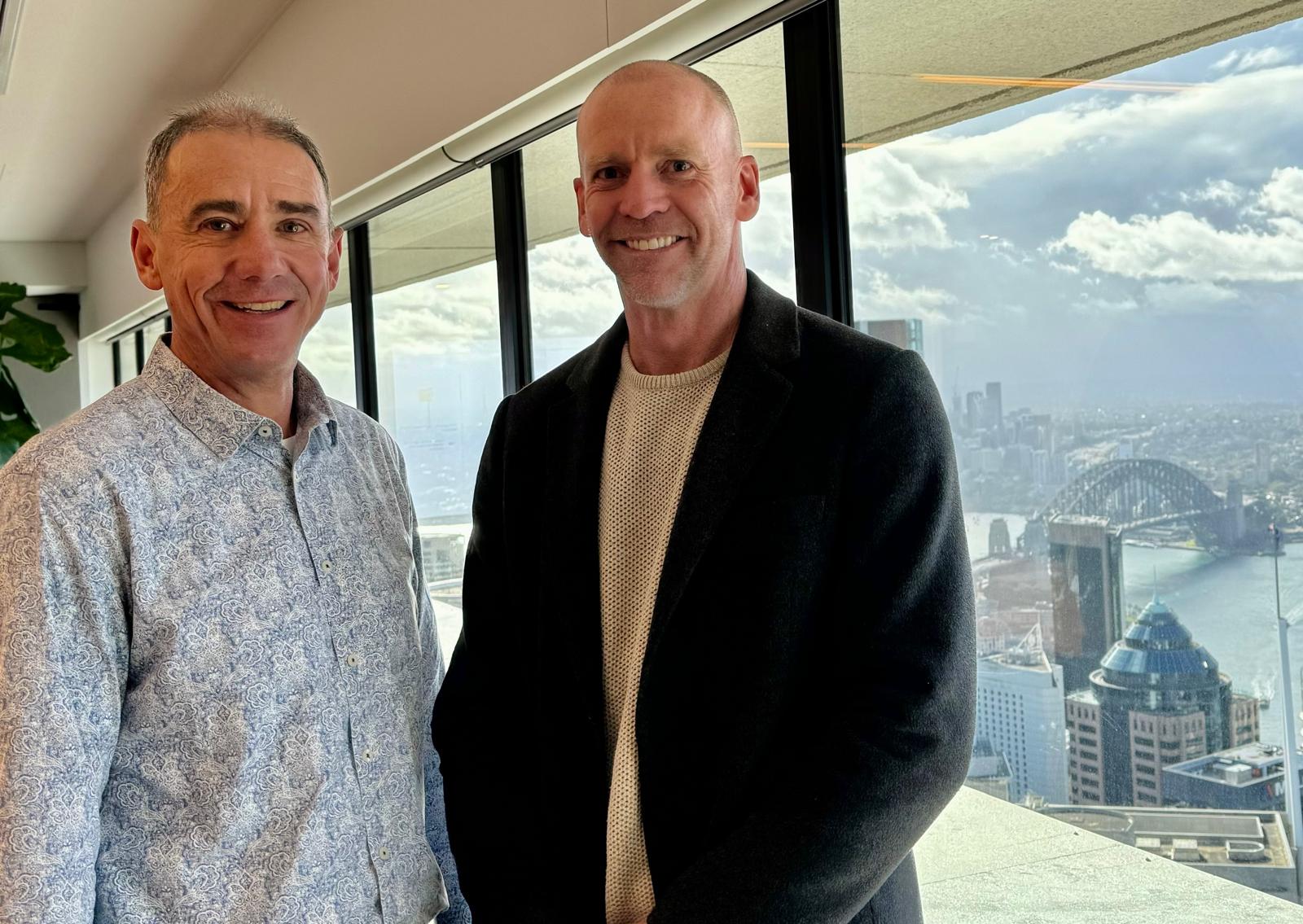
Mark Wright, Managing Director of FEFO Consulting (right), talking strategy with Todd Coates, Founding CEO of Sydney Bridge Climb (left).
Why not Start with Harm Prevention as a Goal?
It is well documented, that a more modern way of viewing safety perfromance is not the absence of harm, but more importantly the presence of effective controls.
Avoiding injury, business disruption, damage to assets, and psychological illness — these are all a set specific, actionable goals.
For many organisations, setting actionable goals is how health and safety change is managed. Each goal is to be reached. Often goals are set based on a series of Key Performance Indicators (KPIs) to reduce or eliminate harm. Often organisations who succeed are few, and also fail at a lot of them. Eventually, health and safety performance either plateaus or is suboptimal. Often results have very little to do with the goals and KPIs being set and nearly everything to do with the Objectives and Key Result (OKR) beliefs, values, practices, systems and behaviours followed.
Sporting Coach: If you’re a coach, your goal might be to win a championship. Your system is the way you recruit players, manage your assistant coaches, and conduct practice.
Entrepreneur: If you’re an entrepreneur, your goal might be to build a million-dollar business. Your system is how you create a value, test product ideas, hire a great team, and launch a minimum viable product.
Musician: If you’re a musician, your goal might be to play great music. Your system is how often you practice, how you break down and tackle difficult tunes, and your method for receiving feedback from your instructor.
Now for the interesting question: if you completely ignored your goals and focused only on your Key Result Areas, would you still succeed?
For example, if you were a football coach and you ignored your goal to win a championship and focused only on what your team does at practice each day, would you still get results?
I think you would.
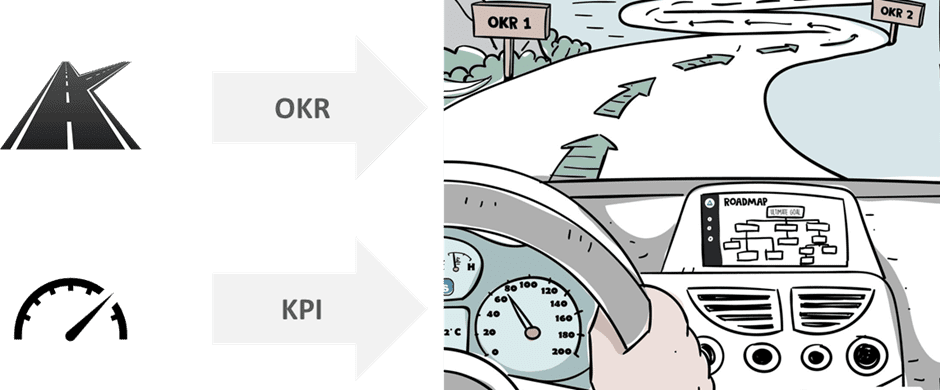
The goal in any sport is to finish with the best score, but it would be ridiculous to spend the whole game staring at the scoreboard. The only way to win is to get better each day. In the words of Mark Wright, “Focus on habits to support your destination, not the dashboard.” The same is true for other areas of workplace safety. If you want better results, then don’t overdose on setting goals and KPIs. Focus on what systems, conditions and behaviours positively influence the desired habits and that ultimately build high performance.
What does this mean? Are KPIs completely useless? Of course not. KPIs are a good indicators but evaluating Objectives and Key Results (OKRs) are best for making progress. A handful of problems arise when you spend too much time thinking about your KPIs and not enough time designing your methods of deploying your OKRs.
Problem #1: Winners and losers have the same goals.
KPI setting suffers from a serious case of survivorship bias. We concentrate on the people who end up winning—the survivors—and mistakenly assume that ambitious goals led to their success while overlooking all of the people who had the same objective but didn’t succeed.
Every football player wants to win the game. Every candidate wants to get the job. And if successful and unsuccessful people share the same KPI, then the goal cannot be what differentiates the winners from the losers. It wasn’t the KPI of winning the championship that propelled the Penrith Panthers to winning four years in a row. Presumably, they had wanted to win the championship every year before — just like every other professional team. The KPI had always been there. It was only when they implemented an OKRs of continuous small improvements that they achieved a different outcome.
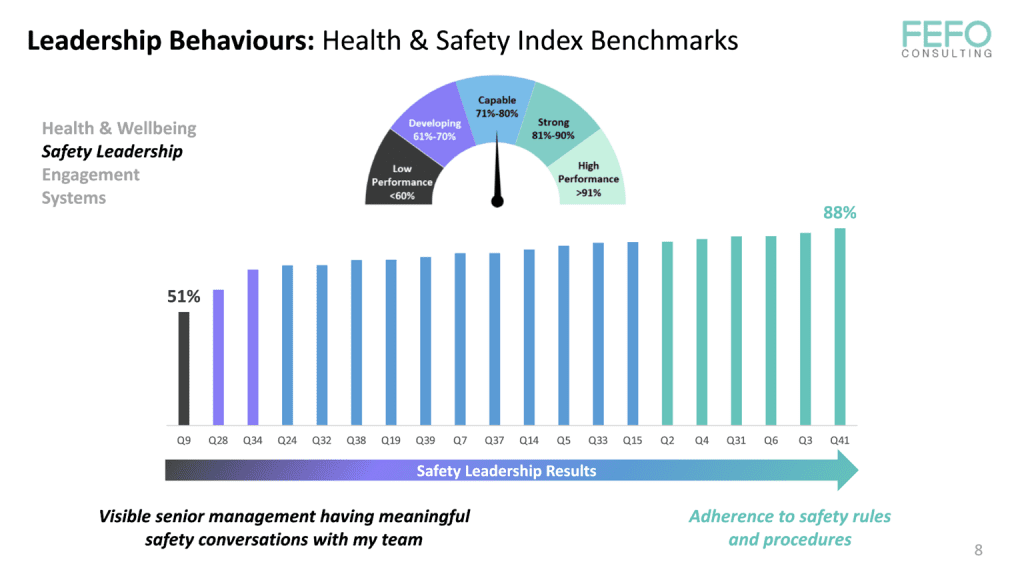
Fix the inputs and the outputs will fix themselves. For more information on inputs and outputs, refer to the Health and Safety Index benchmark results.
Problem #2: Achieving a goal is only a momentary change.
Imagine you have poor workplace housekeeping and you set a goal to keep things in order it. If you summon the energy to tidy up, then you will have a tidy workshop—for now. But if you maintain the same sloppy, pack-rat habits that led to a poor workplace housekeeping in the first place, soon you’ll be looking at a new pile of clutter and hoping for another burst of motivation. You’re left chasing the same outcome because you never changed the system behind it. You treated a symptom without addressing the underlying contributing factors.
Problem #3: Goals restrict success.
The implicit assumption behind any KPI is this: “Once the KPI is reached, then we succeeded.” The problem with a KPI-first mentality is that you’re continually putting happiness off until the next milestone. Organisations often slip into this trap so many times, and this can drive the wrong behaviour, e.g. once the KPI is achieved we can finally relax; or worse, let’s change the way we measure the KPI, not the underlying contributing factors.
Furthermore, KPI create an “either-or” conflict: either you achieve your KPI and are successful or you fail, and you are a disappointment. You mentally box yourself into a narrow version of success. This is misguided. It is unlikely that your actual work done will match the exact journey of work planned. It makes no sense to restrict your satisfaction to one scenario when there are many paths to success.
Problem #4: Goals are at odds with long-term progress.
Finally, a KPI-oriented mind-set can create a “yo-yo” effect. Many runners work hard for months, but as soon as they cross the finish line, they stop training. The race is no longer there to motivate them. When all of your hard work is focused on a particular KPI, what is left to push you forward after you achieve it? This is why many people find themselves reverting to their old habits after accomplishing a goal.
The purpose of setting goals is to win the game. The purpose of building on OKRs is to continually learn, adjust, and improve. True long-term thinking is goal-less thinking. It’s not about any single accomplishment. It is about the cycle of endless refinement and continuous improvement. Ultimately, it is your commitment to the process that will determine your progress.
Fall In Love with OKRs
None of this is to say that KPIs are useless. However, KPIs are good indicator to check your progress and OKRs are good for actually making progress.
KPIs can provide an indicator of short-term progress, but eventually a well-designed system will always win. Having effective systems and controls is what matters. Committing to the process is what makes the difference.
Where to start?
Commence with understanding your current state vs. designed state.
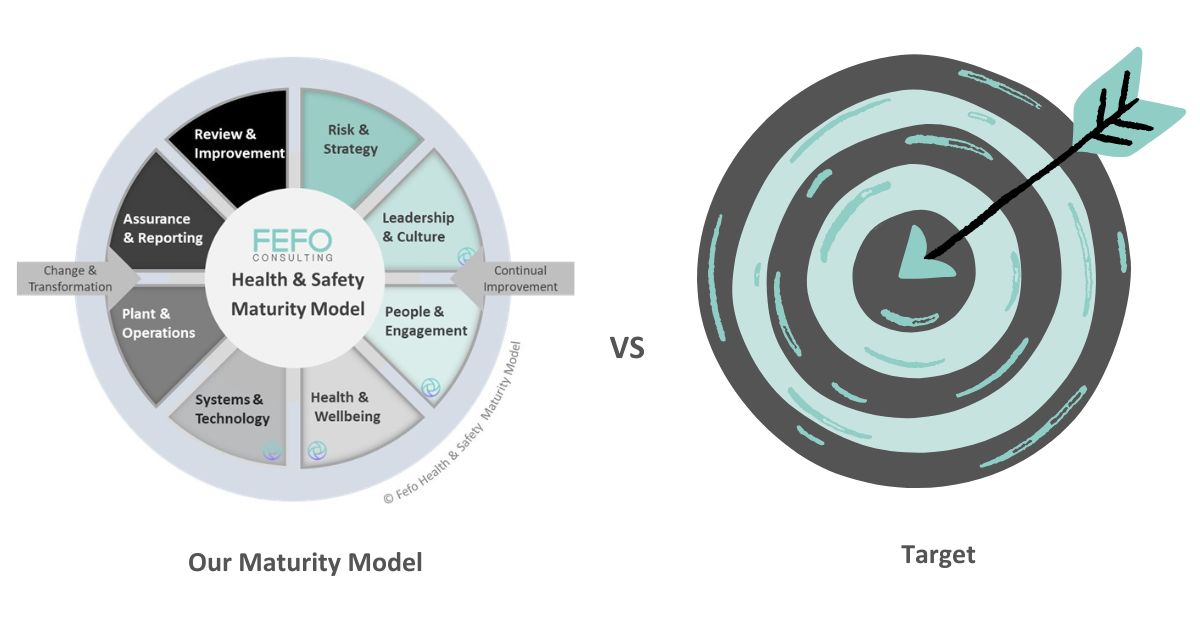
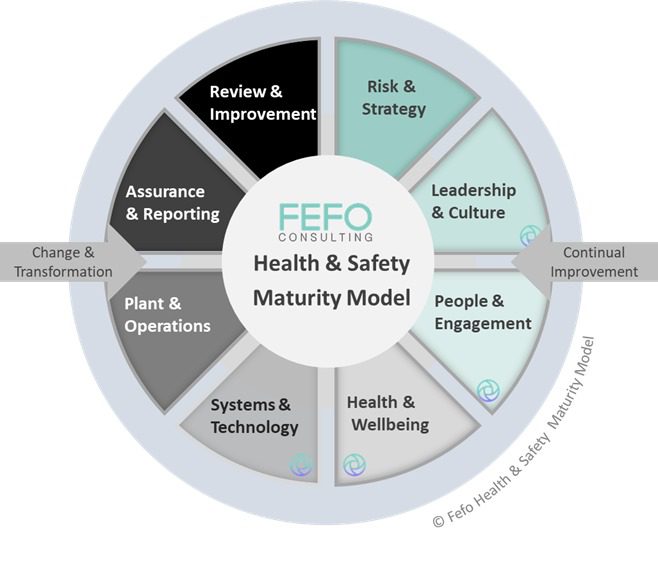
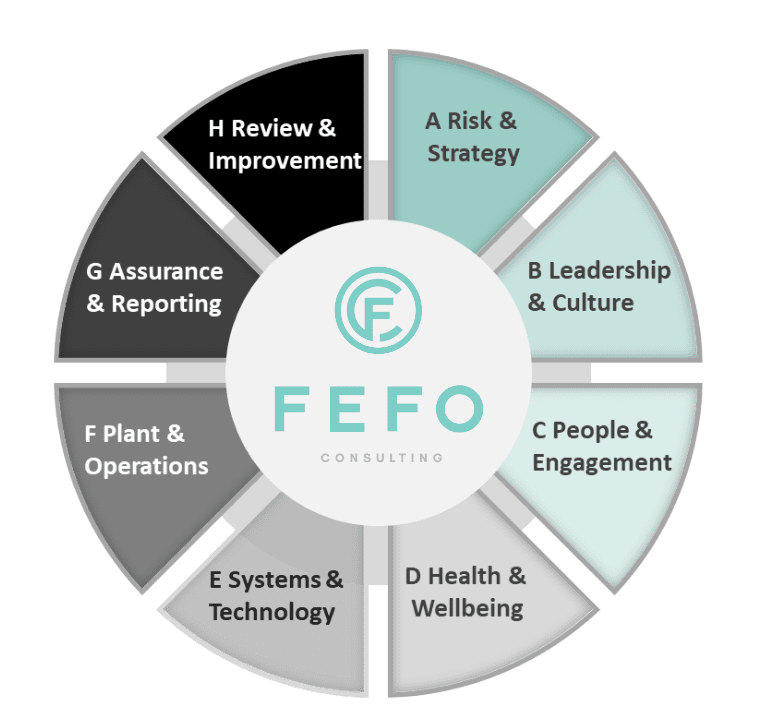
FEFO Consulting has developed a proven Maturity Health and Safety Model that enables organisations to identify areas of focus, prior to establishing a strategy and methods of measuring success. To learn more contact us.
This article is based on Chapter 1 of the New York Times bestselling book AtomicHabits. Read more here.
“You do not rise to the level of your goals. You fall to the level of your systems.”
— James Clear, Writer
Key Steps to Creating an Effective Health & Safety Strategy
FEFO Consulting is dedicated to helping organisations and individuals discover the unknown and identify their blind spots. Through a combination of reliable surveys and experts assessments, we provide accurate insights that guide performance improvement and growth. Let’s delve into how our unique approach works.
Reliable Surveys: Diagnostics Dx
Our Diagnostic (Dx) process utilizes statistically reliable survey benchmarks. This method allows us to gather feedback on a grand scale. It’s not just about collecting responses, but about understanding patterns and trends that help build high performance. We believe that every voice matters, and through our surveys, we make sure every voice is heard.
Experts Assessments: Assessments Ax
Our Assessments (Ax) involve experts evaluating performance against a structured Maturity Model. These assessments are carried out by seasoned professionals who have years of experience in their respective fields. They use a comprehensive and structured model to evaluate and rate performance. This model provides a clear framework for identifying strengths and areas for improvement.
Wide Range of Assessment Areas
Our assessments aren’t just confined to one or two areas. We believe in providing comprehensive insights, and for that, we cover a wide range of areas. Some of the key areas include:
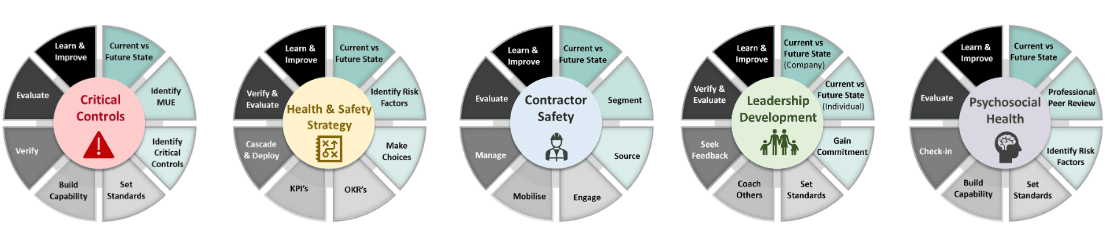
Organisational Safety Ax: Assessing the safety measures and protocols in place across the organisation.
Leadership Safety Ax: Evaluating the role of leadership in fostering a safe and secure work environment.
Contractor Safety Ax: Checking the safety standards and protocols followed by contractors associated with the organisation.
Critical Control Ax: Reviewing the critical controls in place for various processes and operations within the organisation.
And that’s not all. We have many more areas that we cover in our assessments. Each area is carefully chosen and evaluated to provide a holistic view of the organisation’s performance and potential blind spots.
The Ultimate Goal: Discover the Unknown
Our ultimate aim is to help you discover the unknown. We believe that every organisation and individual has the potential to grow and excel. But sometimes, blind spots can hinder progress. By identifying these blind spots, we provide a clear path for improvement and success. We believe that our unique approach of combining reliable surveys and expert assessments can help in this endeavor.
So, if you’re ready to discover your blind spots and take your performance to the next level, get in touch with us today. We’re here to help you succeed.
Psychosocial Recent Trends
In recent years, the attention on mental health in the workplace and community has increased substantially. Greater levels of attention is a positive step to improving a very challenging and often stigmatised topic. The Health and Safety Index benchmark results 2020 vs 2021, reported improvements in responses to “I feel comfortable talking about mental health” ↑ up 5%. This was the greatest positive improvement of all 55 benchmark questions.
Despite this improvement, the actual Health and Safety Index benchmark results for “feeling comfortable talking about mental health” are in the bottom quartile, indicating we have a long way to improve compared to other health and safety behaviours, conditions and practices.
We have also seen the introduction of several international and domestic guidance materials from regulators to assist with managing psychosocial factors in the workplace, e.g.
This article specifically provides a comparison between:
ISO 45003: Occupational health and safety management – Psychological health and safety at work – gives guidance on managing psychological health and safety risks; and
SafeWork Australia: Model Code of Practice: Managing psychosocial hazards at work.
For a detailed comparison, press the download button to receive a copy of our Psychosocial Hazard Factsheet: ISO 45003 vs Code of Practice.
Standards vs Code of Practice
In general terms, Codes of Practice provide detailed information on how you can achieve the standards required under Work Health and Safety (WHS) laws. Codes of Practice do not replace the WHS laws, but can be help provide an understanding on how to apply legal requirements.
Worth noting, Victoria will be the first jurisdiction in Australia to legislate the specific requirement for psychosocial risk assessments.
Similarities: ISO 45003 and Model Code of Practice
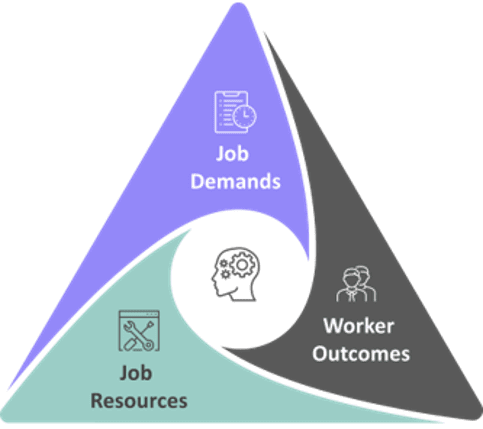
There are many common areas between ISO 45003 and the Code of Practice. Both documents address psychological health sources of harm and potential risk factors covering both job demands and job resources. Both of these documents provide guidance on the management of psychosocial workplace factors in relation to:
Design or management of work
Process and system
Working environment
Plant and equipment
Interactions, cultures, values and behaviours.
Interestingly, both documents are very limited in their guidance on worker impacts and outcomes.
Differences: ISO 45003 vs Model Code of Practice
Despite ISO 45003 being 50% smaller by page number compared to the Code of Practice, it really provides a detailed outline managing psychosocial risks. Key distinctions with ISO 45003, are as follows:
ISO 45003
One of the most obvious differences between ISO 45003 and the Code of Practice is the structure of the guidance. ISO 45003 provides broader considerations to enable alignment with ISO 45001 OHS management systems (Plan-Do-Check-Act). This guidance is great for organisations with mature systems who can simply integrate the management of psychosocial factors into existing systems and practices. For more information on the relationship with ISO 45001, refer to our ISO 45003 vs 45001 blog.
ISO 45003 provides a greater guidance on the following areas:
Job Demands: Greater focus on job security, uncertainty regarding work availability, non-standard employment that is low paid and/or insecure and working in situations that are not covered or protected by traditional employment laws or social protections.
Job Resources: Greater focus on team and work group cohesion. It also provides a more detailed outline of leadership behaviours and activities Leaders can undertake.
Definitions: Provides more comprehensive definitions, e.g., wellbeing, physical, mental, social, and cognitive health.
Model Code of Practice
Compared to ISO 45003, the Code of Practice is structured to align with operational risk management principles (ID-Assess-Control-Review-Record-Investigate). Other key differences are the emphasis on trauma, emotional demands, and empathetic leadership. Although trauma is often associated with acute events, it also can be chronic or cumulative, e.g., “compassion fatigue” and repeated exposures to emotional situations. Compared to ISO 45003, the Code of Practice has a greater focus on the following areas:
Structure: Aligned with risk management principles of hazard identification, risk assessment, risk control Review-Record-Investigations
Job Demands: Greater focus on trauma and emotional demands
Job Resources: Greater focus on empathetic leadership
Appendix: Provides an example Risk Register.
Summary: ISO 45003 vs Model Code of Practice
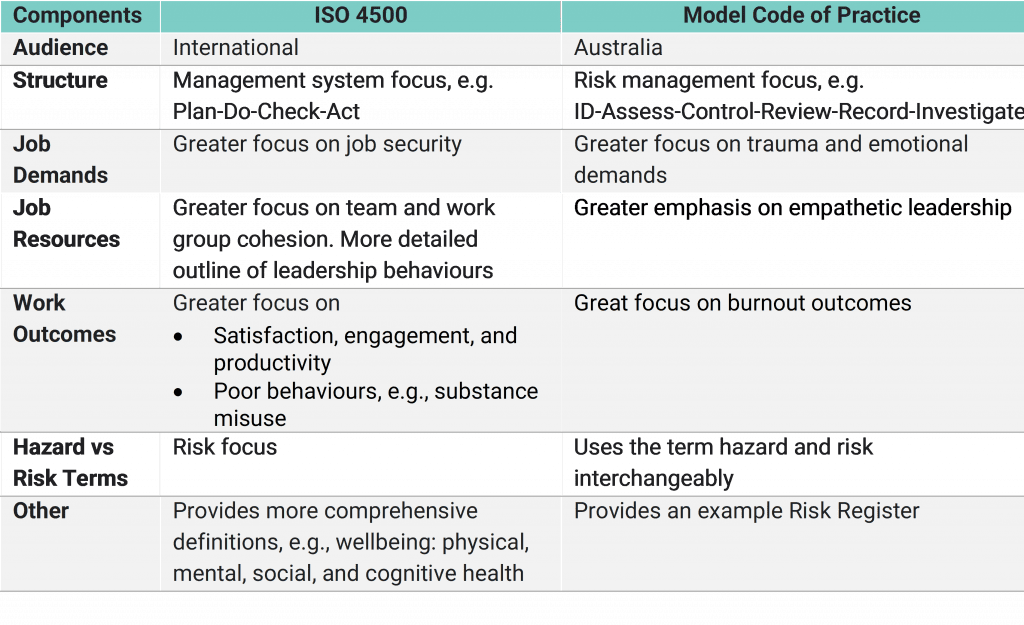
A summary of key differences between ISO 45003 vs Code of Practice are outlined in Table 1 below
Table 1: ISO 45003 vs Model Code of Practice Summary
For a more detailed comparison, press the download button to receive a copy of our Psychosocial Hazard Factsheet: ISO 45003 vs Code of Practice.
FEFO Consulting has partnered with the Health and Safety Index to design integrated online assessments to measure health AND safety performance supported by reliable benchmarks.
If you need help with Health and Safety, Wellbeing or Psychosocial maturity assessments, risk assessments, strategy, training, or other specific interventions – contact us today via email or call +61 1300 909 649
In today’s world, change is constant, at FEFO Consulting we see many successful businesses large and small who are facing intense pressure to be more efficient, innovative, and productive – all while reducing risk and adapting to changing work conditions, client needs and regulatory environments.
Often time is the most valuable commodity. Across the business landscape, agility is becoming more important than rigid standardisation, and the basis of effective strategy is shifting from consistency to adaptability. Recognizing constant change, many organisations are adopting agile ways of working—pioneered by the tech industry—to set priorities, allocate resources, empower teams to make decisions quickly and adapt to the changing needs.
The goal is to achieve what we call fast execution. At its core, fast execution is about minimising hierarchy, bureaucracy and unleashing the creativity and judgment of the people closest to the work or project and collaborating more effectively together. The goal is to use increased autonomy in the team to create an environment where people with differing levels of capability come together to deliver outstanding performance every day—and where learning happens continuously and transparently together.
In a recent FEFO Consulting webinar the level of collaboration to track strategic performance was reported being extremely low.
~10% of participants stated they involved operations in reviewing their Health and Safety strategy at least quarterly.
Unfortunately, in today’s fast paced moving operational environments, companies enable business support functions like safety, HR, finance, IT and procurement with strategic autonomy before ensuring they have clear methods to track strategy effectiveness in a collaborative way. Autonomy without alignment and collaboration can rapidly lead to chaos.
Agile execution to work, requires an agile strategy and collaborative mindset.
OKR vs KPI
THREE FAST STRATEGY IMPERATIVES FOR LEADERS
To ensure agile teams are aligned on objectives, the Leadership Team must do three things: communicate a consistent purpose, coordinate resources, and design for speed.
Communicate a consistent purpose. The more complex and fast moving the external environment, the more important it is to align agile teams on a stable overarching purpose or mission. The best mission statements are simple and aspirational. High Performing Support Functions (e.g. Safety, HR, Finance, IT, Procurement) link and communicate how their strategies enable the company’s purpose.
Coordinate resources. The more complex your organisation and number of stakeholders the more important it is to align resources, ownership, and methods of collaboration to make effective decisions.
Is your business clear on how your operating model fits the strategy?
Do you have the right balance of ownership between operations and business support functions?
Are you bringing the right people and capability together with different perspectives and experiences to share common goals?
An effective approach is to bring strategy and budgeting processes for Support Functions, into a single operating system that encompasses goal setting, strategic planning, resource allocation, and performance management.
Design for speed. Agile, responsive organisations create an ongoing strategic loop by making deliberate, appropriate changes to communication structures and functional silos. To ensure that communication is two-way rather than just cascading down from the top, such organisations hold regular forums in which agile teams play back their understanding of what their objectives are and how they plan to achieve them. It is important to regularly showcase how objectives are met with key stakeholders, so not only can teams celebrate success, but so there can also be continued leadership support, enabling quick decisions to be made.
In an agile organisation, everyone is expected to exercise judgment, so leaders have an obligation to distill strategy and objectives to their essence—to give teams the freedom to innovate and outsource to experts to operate at speed, e.g., Business Process Outsourcing (BPO).
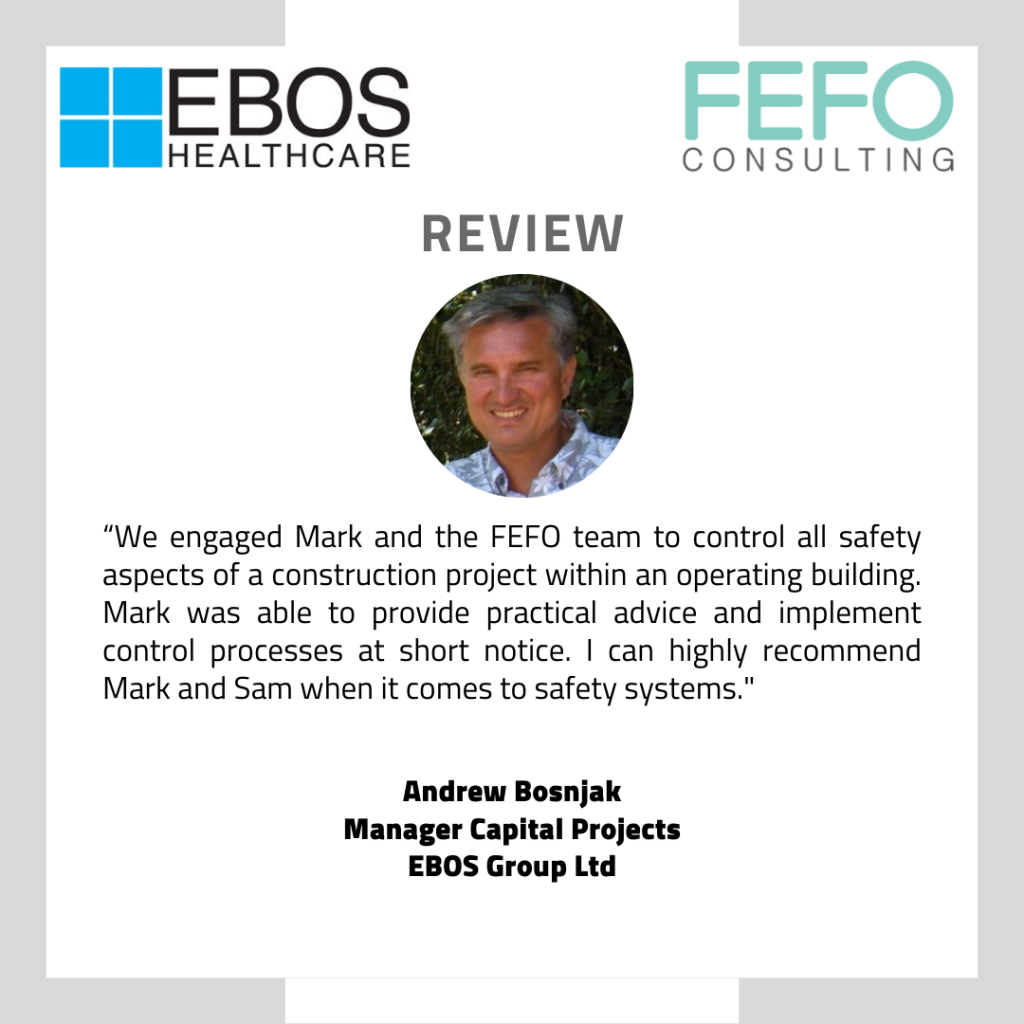
FEFO Consulting was recently engaged by the Ebos Group as an outsourced safety resource to assist with short-term construction contractor management. This allowed Ebos to focus on core business and leverage the expertise and speed of the FEFO Consulting team.
Ebos Review
Executing with Excellence
To reap the strategic benefits of speed, organisations need to marry fast strategy to fast execution. Only when equipped with a shared understanding of the organisational landscape and the Leadership Team’s strategic intent will agile teams be in a position to effectively deliver and manage threats and opportunities —over and over again. Without clarity as to strategy, goals, resources, and methods to track performance, autonomy can quickly descend into chaos. In other words, the more alignment, the more autonomy organisations can grant.
In a tempo-driven organisation, everyone’s attention is focused on the strategic objectives and how to achieve them effectively at speed.
If you need some guidance on developing and deploying an effective strategy, contact us today.
FEFO Consulting recently is introducing new contractor safety assurance services to assist clients with ensuring effective procurement of services. To support these services, we are leading a 5-part webinar series on contractor safety in partnership with myosh.
How much influence and control is reasonable when managing contractor health and safety? Managing health and safety when contracting is not black and white. In fact, there are different risk profiles, different contract types and stakeholder requirements.
This webinar will outline obligations, threats and opportunities when managing contractor health and safety. Contractor management can be complex and a burden for multiple stakeholders if not deployed effectively. Conversely, simplifying contractor management based on risk can provide huge amounts of opportunity to reduce compliance burdens, effectively engage stakeholders, and build high-performing cultures.
Engineer and contractor shaking hands success of the project work together.
1. Selecting & Engaging Contractors
This webinar is Part 1 of 5 and will provide considerations when selecting and engaging contractors. A practical case study on considerations to get started. Join Mark Wright and Ben Kirkbride.
Key takeaways: • Segmenting contractors • Selecting: Tendering and other sourcing options • Engaging: Pre-qualifying and contract agreements.
A risk-based approach to contractor pre-qualifications
Segmenting Simplify Contractor Safety
2. Mobilising Contractors
This webinar is Part 2 of 5 and will outline methods to engage contractors prior to work commencing to ensure readiness. Join Mark Wright and Laura Blampid from Skout Solutions.
Key takeaways:
Visible leadership: Visible leadership was the lowest scoring Health and Safety Index Leadership result in 2021. Despite this challenge, effective leadership can create far more value when mobilising contractors compared to focusing too heavily on rules and compliance
Labour hire: Understanding roles of asset owner, principal contractor, and other stakeholders
Work Readiness: Mobilisation activities based on different types of contractors.
3. Managing Contractors
This webinar is Part 3 of 5 and will outline outsourcing solutions for managing short-term high-risk contractors. Join Mark Wright and Alex Sciascia from Ventia.
Key takeaways:
Outsourcing vs Insourcing
Communicating known hazards
Delegations and authorities: e.g. who signs the permit?
This webinar is Part 4 of 5 and will outline how to apply critical control management and examples of how to reflect, learn and improve when working with contractors. Join Mark Wright and Amelia Simony from Spaceframe.
Key takeaways:
Confirming critical controls when working with contractors
WHS Governance and control effectiveness
Methods to collaborate, benchmark performance, learn and improve.
Where to focus contractor safety resources?
Aligning contractor safety assurance with objectives and resources
Using the Health and Safety Index understand contractor performance
5. Contractor Safety Technology
This webinar is Part 5 of 5 and outlined technology options with myosh.
Our Unique Assessment Method
What is your Current vs Desired State?
Not all businesses are created equal. Different industry, needs, stakeholders and capability. For this reason, we developed a flexible contractor safety assurance method to suit most organisations.
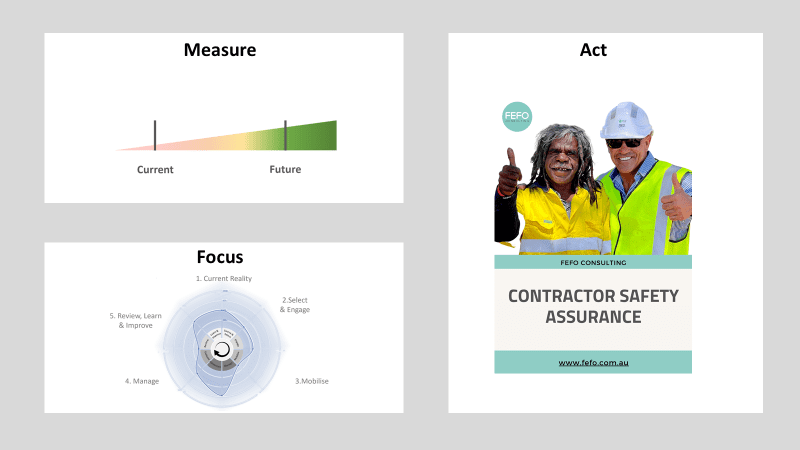
Contractor Safety Assurance
Tips for Contractor Safety
To access our ‘4 Steps to Contractor Safety’, click on the download guide button below:
To learn more from our Contractor Safety case studies, refer to our Success Stories webpage.
Contact us to better understand how you can improve contractor safety.
M: +61 417 570 143
FEFO Consulting recently launched our Critical Control Management (CCM) Workbook, a step-by-step guide to effectively managing critical controls. Our Workbook provide a framework for taking a risk-based approach aligned with international guidance and experience with multiple CCM implementation projects.
This CCM workbook covers:
Material Unwanted Events & Critical Controls
Standards & Capability
Verification & Evaluation
Review, Learn & Improve
Our self-directed CCM Workbook is supported by a simple self-assessment tool providing a selection of 5 different options based on desired maturity levels.
5-Part Webinar Series: Critical Control Management (CCM)
FEFO Consulting is delivering a 5-part series which will provide simple and effective tips on how to deliver a CCM. This will include case studies, shared learning, and guest speakers from several multinational organisations, like Lockheed Martin, Jones Lang LaSalle (JLL), and Natural Resource Australasia.
5-Part Webinar Series
1. Material Unwanted Events (MUE)
This webinar is Part 1 of 5 and provides a simple Introduction to identify Material Unwanted Events (MUE) with high potential consequences. Practical case studies also include tips on mapping major hazards and safety materiality.
Health and Safety Materiality
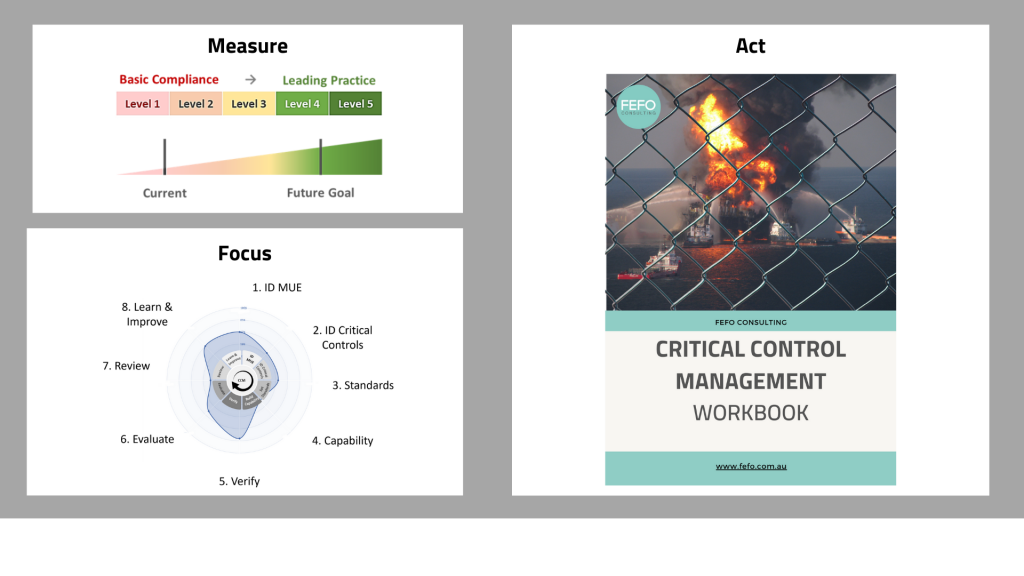
Measure | Focus | Act
2. Critical Controls
This webinar is Part 2 of 5 and outlined different types of risk analysis option when evaluating Material Unwanted Events (MUE) and methods to identify critical controls. A practical case study will also be provided outlining how to identify critical controls pitfalls.
Pitfalls and Leading Practices
Case Study
3. Critical Control Performance Standards
This webinar is Part 3 of 5 and outlined options for setting critical control performance standards. In additional, practical case studies were provided on setting expectations for assurance activity and attributes of effective critical controls.
70:20:10 Principles
Getting the Basics Right First
4. Critical Control Verification
This webinar is Part 4 of 5 and outlined options for verifying critical controls and evaluating a broader Critical Control Management (CCM) program . In additional, practical case studies were provided by Rebecca Crompton, General Manager, HSE from BSA Ltd.
Checking What Matters!
Supply Chain Critical Controls
Shifting Mindsets
5. Critical Control Performance Mesurement
This webinar is Part 5 of 5 and outlined options for Critical Control Management (CCM) performance measurement. This also included options for a balance scorecard and insights on Environment, Social and Governance (ESG) reporting from Wade Needham, General Manager, EHS, Natural Resources Australasia.
Impact of Poor CCM on Shareholder Value
Lead, Lag and Predictive Indicators
Identifying Specific Behaviours
Our Unique Assessment Method
What is your Current vs Desired State?
Not all businesses are created equal. Different industry, needs, stakeholders and capability. For this reason, we developed a 5 Level maturity assessment approach, allowing organisations to set their own goals.
“Avoid using a sledgehammer to crack a nut!”
Choose your own goals, and we tailor both the assessment and solutions to meet your needs. Based on your results, we provide unique solutions to meet your need.
CCM Assessment
Tips for Critical Control Management (CCM)
Here are a few tips when outsourcing health and safety activity:
Measure – Evaluate current performance based on your unique context (Level 1-5) to understand current vs. desired state
Focus – Understand areas of focus to prioritise what is important
Act –Develop an action plan, identify expertise and resources needed to enable improvements that matter!
To learn more from our CCM case studies, refer to our Success Stories webpage.
Contact us for a free 1-hour discovery session during the month of November 2021 to assist with effective implementation of Critical Control Management (CCM) and avoid unintended consequences.
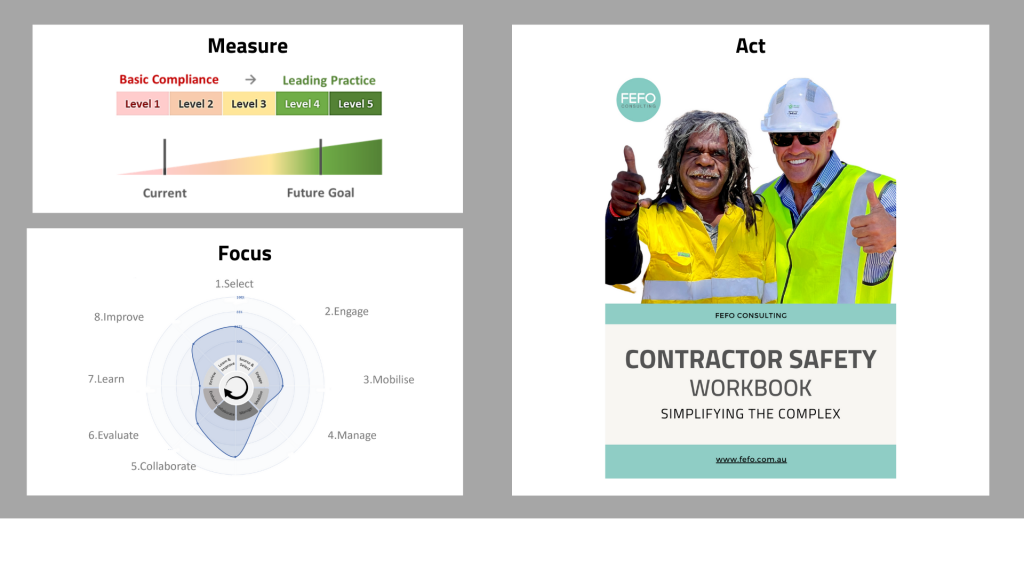
FEFO Consulting recently launched our Contractor Safety Workbook, a step-by-step guide to managing contractor and supplier safety. Our Workbook provides a framework for taking a risk-based approach a strong justification for “simplification” to make life easier and controls more effective.
This workbook covers:
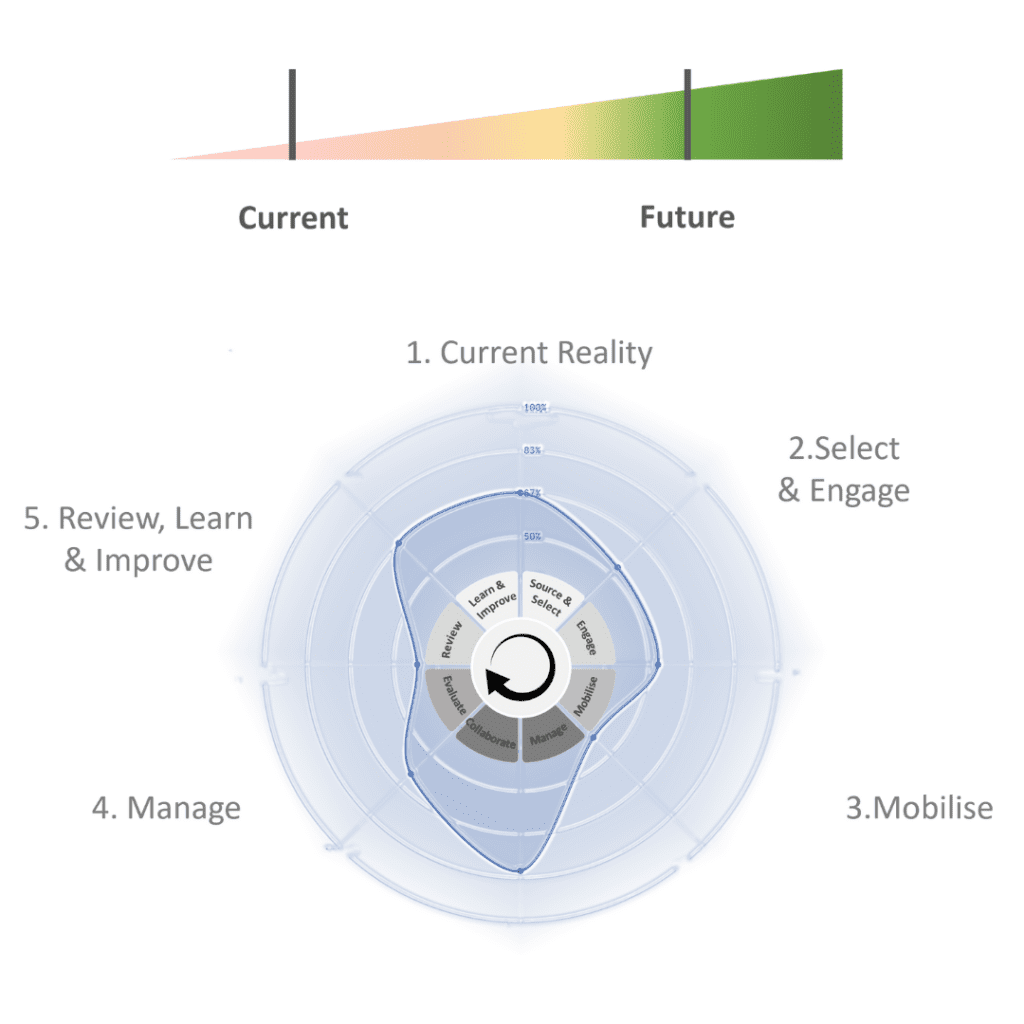
Current Reality
Select & Engage
Mobilise & Manage
Evaluate & Collaborate
Learn & Improve
This Workbook “Choose Your Own Adventure” is supported by a simple self-assessment tool enabling you to understand your Current Reality vs Desired State with a selection of 5 different options based on your desired maturity level.
This covers a number of different contracting arrangements, e.g., Labour-hire, Principal Contractors, and independent contractors.
Our Unique Assessment Method
What is your Current vs Desired State?
Not all businesses are created equal. Different industry, needs, stakeholders and capability. For this reason, we developed a 5 Level maturity assessment approach, allowing organisations to set their own goals.
“Avoid using a sledgehammer to crack a nut!”
Choose your own goals, and we tailor both the assessment and solutions to meet your needs. Based on your results, we provide unique solutions to meet your need.
4-Steps to Contractor Safety
Segment & Source – Apply a risk-based approach to categorise contractors, confirm methods of sourcing and contract agreements.
Engage & Mobilise – Pre-qualify to ensure compliance and maximize value. Induct, set clear expectations and verify permits.
Manage & Monitor – Manage contractors, verify effectiveness and provide assurance.
Contact us for a free discovery session to assist with contractor safety and an outline of our new Contractor Safety Workbook: A Step-by-Step resource to effectively implement contractors and suppliers.
FEFO Consulting recently joined SAP on their Future of Mining podcast to discuss contractor safety. We also covered this topic in a recent workshop organised by the National Safety Council of Australia (NSCA).
What are the challenges when balancing productivity and external workforce safety?
Forbes recently published an article featuring FEFO Consulting, the Health and Safety Index. This article also included SAP Fieldglass research in collaboration with Oxford Economic study showing a massive 42% spend in the workforce on external labour. Not just in one particular industry – across them all. So it’s clearly an industry-wide issue that needed to be addressed.
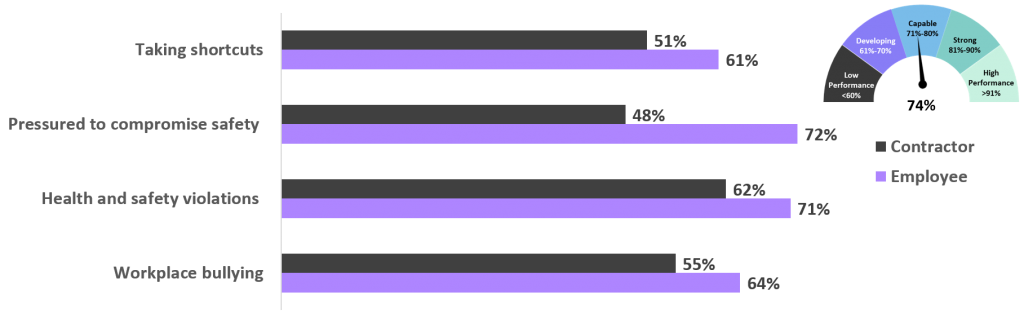
Our own Health and Safety Index confirmed this challenge, by providing benchmarked results on safety, engagement, leadership and systems. We collated this from over 200,000 data point responses in asset intensive companies (based primarily in Australia and New Zealand).
Witnessing colleagues compromise safety – all for the sake of shortcuts – 10% worse with contractors
Feel pressured to compromise safety to complete a job – 24% worse results with contractors
Observed workers violate safety rules – 9% worse with contractors
Bullying – Witnessed bullying to work colleagues –also 9% worse with contractors
In addition, the Australian Council of Superannuation Investors (ACSI) published figures in December 2019 outlining, the percentage of contractor fatalities in ASX 200 companies.
70 percent of fatalities in ASX 200 companies were contractors.
ACSI, December 2019
This is not good enough. But what can be done?
External workforces often consist of short-term labour that’s expected to carry out complex, specialised work at speed as they interact with numerous stakeholders. In driving a high performance culture, don’t put productivity before safety. That leads to a culture of rushing to get the job done, as opposed to looking after your workmates and coming home safely.
Can we minimise risk by simplifying processes and making cultural changes?
As the Principal or Head Contractor, can you treat a small sole trader contractor differently to a large multinational company tendering for a 5-year contract?
The short answer? Yes. The is often a fear of legal breaches leading to over compliance and over the top (OTT) paperwork! For this, we recommend a risk-based approach to managing compliance and also create high performing cultures.
Here are some quick tips:
Identify areas of focus: Targeted approach and prioritise resource
Evaluate threats and opportunities: Understand risks and maximise value
Implement actions: Execute with excellence
Review and improve: Track portfolio performance against initial targets
Where are opportunities to innovate?
The external workforces provides a lot of areas in which we can find innovation opportunities. We urge all organisations to avoid focusing purely on compliance when managing contractors, and think about the numerous ways suppliers can add more value.
“If you want a basic focus on compliance, ask contractor pre-qualification questions that are only based on compliance. If you want to create a collaborative culture of innovation, ask pre-qualification questions to challenge and motivate contractors to add value, i.e. adding health & safety value to both their own and your supply chain.”
Mark Wright
Getting insights right from the source is the best way to improve your workplace safety, and adapt quicker to fast-moving risks and threats.
If you need some guidance in optimising the safety of your contractors, contact us today.
Do companies focus too much on individuals and lower order controls?
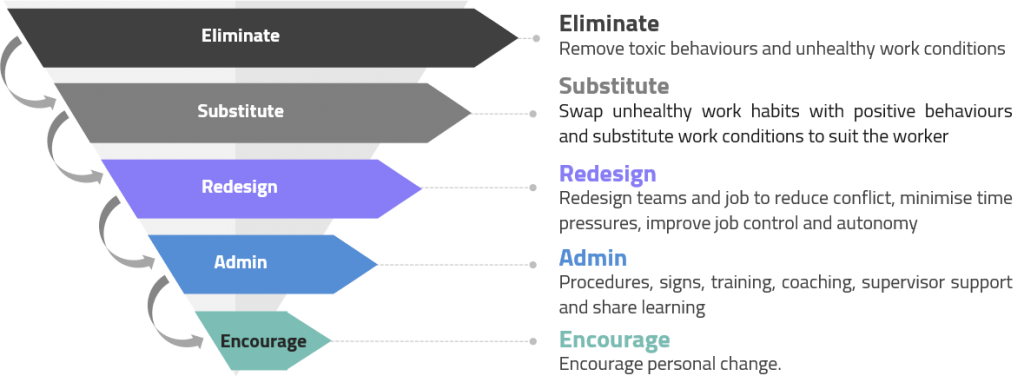
Too often organisations focus on individuals and lower order controls such as training and mindfulness, rather than focusing on job design, job demands and organisational resources.
The ‘Hierarchy of Controls Applied to NIOSH Total Worker Health’ provides a conceptual model for prioritising efforts to advance the safety, health, and wellbeing of all workers.
NIOSH1 Total Worker Health Hierarchy of Controls
Manual Handling Analogy
If the job demands of lifting boxes was too difficult, would you:
a) Provide education and tell the work to visit the gym and getter fitter
or
b) Complete an assessment to determine job demands, job resources and apply the hierarchy of controls, e.g. eliminate the load, swap load with a lighter product and / or provide lifting aids.
Health & Wellbeing
Psychosocial hazards are not universally understood and often much harder to evaluate compared to physical safety hazards, e.g. the impact of a heavy box leading to a sprain or strain.
The hierarchy of controls has been a legal requirement for many years. That alone, it not the sole reason to apply the hierarchy of controls to psychosocial risks. If a company can redesign the job demands to match the needs of a worker, it just makes sense.
Realistic time pressures2 are often associated with lower health and wellbeing performance. Understanding both job demands, job resources and effective controls are critical to understanding the impacts on worker health & wellbeing.
Conclusion
Taking a risk based approach to health and wellbeing is a logical, yet sometimes challenging activity to complete effectively.
We recommended assessing psychosocial risk using the latest research and expert advice, rather becoming overly reliant on training and other lower order controls.
Applying the hierarchy of controls to tasks to job demands, job resources and worker outcomes can reduce risk and provide a positive Return on Investment (ROI)3.
Have you completed a formal assessment to determine the health and wellbeing controls that are relevant to your organisation?
Contact us to learn more:
M: +61 1300 909 649
E: info@fefo.com.au
Source1: Adapted from NIOSH [20160]. Fundamentals of total worker health approaches: essential elements for advancing worker safety, health, and well-being. By Lee MP, Hudson H, Richards R, Chang CC, Chosewood LC, Schill AL, on behalf of the NIOSH Office for Total Worker Health. Cincinnati, OH: U.S. Department of Health and Human Services, Centers for Disease Control and Prevention, National Institute for Occupational Safety and Health, DHHS (NIOSH) Publication No. 2017-112.
Source3: Creating a mentally healthy workplace: Return on investment analysis, PwC
The Health and Safety Index is working with several organisations throughout the month of October to support unique safety campaigns.
During these unprecedented times, the Health and Safety Index is a great way to engage employees and contractors to receive feedback at scale, engage a remote workforce, identify blind spots and celebrate successes!
For more information, to receive a complimentary demo or trial, contact us anytime.
M: +61 (0) 417 570 143
E: info@healthandsafetyindex.com.au
What we do
We help organisations simplify critical aspects of health and safety by strengthening controls and enabling high performance.