In today’s world, change is constant, at FEFO Consulting we see many successful businesses large and small who are facing intense pressure to be more efficient, innovative, and productive – all while reducing risk and adapting to changing work conditions, client needs and regulatory environments.
Often time is the most valuable commodity. Across the business landscape, agility is becoming more important than rigid standardisation, and the basis of effective strategy is shifting from consistency to adaptability. Recognizing constant change, many organisations are adopting agile ways of working—pioneered by the tech industry—to set priorities, allocate resources, empower teams to make decisions quickly and adapt to the changing needs.
The goal is to achieve what we call fast execution. At its core, fast execution is about minimising hierarchy, bureaucracy and unleashing the creativity and judgment of the people closest to the work or project and collaborating more effectively together. The goal is to use increased autonomy in the team to create an environment where people with differing levels of capability come together to deliver outstanding performance every day—and where learning happens continuously and transparently together.
In a recent FEFO Consulting webinar the level of collaboration to track strategic performance was reported being extremely low.
~10% of participants stated they involved operations in reviewing their Health and Safety strategy at least quarterly.
Unfortunately, in today’s fast paced moving operational environments, companies enable business support functions like safety, HR, finance, IT and procurement with strategic autonomy before ensuring they have clear methods to track strategy effectiveness in a collaborative way. Autonomy without alignment and collaboration can rapidly lead to chaos.
Agile execution to work, requires an agile strategy and collaborative mindset.
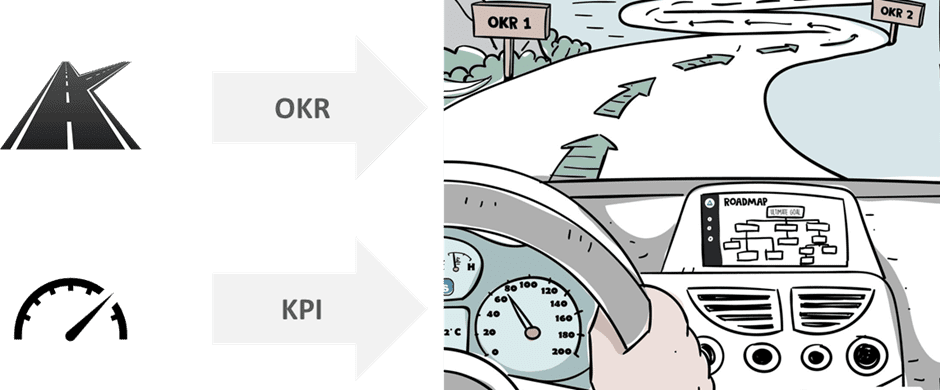
OKR vs KPI
THREE FAST STRATEGY IMPERATIVES FOR LEADERS
To ensure agile teams are aligned on objectives, the Leadership Team must do three things: communicate a consistent purpose, coordinate resources, and design for speed.
Communicate a consistent purpose. The more complex and fast moving the external environment, the more important it is to align agile teams on a stable overarching purpose or mission. The best mission statements are simple and aspirational. High Performing Support Functions (e.g. Safety, HR, Finance, IT, Procurement) link and communicate how their strategies enable the company’s purpose.
Coordinate resources. The more complex your organisation and number of stakeholders the more important it is to align resources, ownership, and methods of collaboration to make effective decisions.
Is your business clear on how your operating model fits the strategy?
Do you have the right balance of ownership between operations and business support functions?
Are you bringing the right people and capability together with different perspectives and experiences to share common goals?
An effective approach is to bring strategy and budgeting processes for Support Functions, into a single operating system that encompasses goal setting, strategic planning, resource allocation, and performance management.
Design for speed. Agile, responsive organisations create an ongoing strategic loop by making deliberate, appropriate changes to communication structures and functional silos. To ensure that communication is two-way rather than just cascading down from the top, such organisations hold regular forums in which agile teams play back their understanding of what their objectives are and how they plan to achieve them. It is important to regularly showcase how objectives are met with key stakeholders, so not only can teams celebrate success, but so there can also be continued leadership support, enabling quick decisions to be made.
In an agile organisation, everyone is expected to exercise judgment, so leaders have an obligation to distill strategy and objectives to their essence—to give teams the freedom to innovate and outsource to experts to operate at speed, e.g., Business Process Outsourcing (BPO).
FEFO Consulting was recently engaged by the Ebos Group as an outsourced safety resource to assist with short-term construction contractor management. This allowed Ebos to focus on core business and leverage the expertise and speed of the FEFO Consulting team.
Ebos Review
Executing with Excellence
To reap the strategic benefits of speed, organisations need to marry fast strategy to fast execution. Only when equipped with a shared understanding of the organisational landscape and the Leadership Team’s strategic intent will agile teams be in a position to effectively deliver and manage threats and opportunities —over and over again. Without clarity as to strategy, goals, resources, and methods to track performance, autonomy can quickly descend into chaos. In other words, the more alignment, the more autonomy organisations can grant.
In a tempo-driven organisation, everyone’s attention is focused on the strategic objectives and how to achieve them effectively at speed.
If you need some guidance on developing and deploying an effective strategy, contact us today.
Download our OKR Template
Don’t miss out on our Newsletters!
Sign up for industry leading news, case studies and informative videos…
Is your health & safety strategy right for 2022-23?
Is your health & safety strategy effective? Do your metrics allow you to learn, adjust and improve?
If either your strategy is wrong or metrics are in effective, there is a good chance there are lost opportunities for success.
FEFO Consulting was recently engaged by a major council to assist with the development and deployment of health & safety strategy.
Our recent blog shared learning from this experience:
OKR vs KPI: Measuring Health and Safety Metrics that Matter
The Objective Results (OKR) approach to setting goals is a great way to effectively support a strategy and has been used at Google, LinkedIn Airbnb, and many more. OKR’s are often complimented by Key Performance Indicators (KPI).
FEFO Consulting recently is introducing new contractor safety assurance services to assist clients with ensuring effective procurement of services. To support these services, we are leading a 5-part webinar series on contractor safety in partnership with myosh. The 5-part webinar series covered:
FEFO Consulting was recently engaged to lead an evaluation of material unwanted events and critical controls across multiple NBN service providers.
One reason for this project was an industry led response to the tragic fatality in 2016 related to a worker completing horizontal directional drilling. To find out more about FEFO Consulting critical control services, refer to our blog or contact us to find out more.
Dates for the Diary
Training: Develop and deploy an effective WHS Strategy – contact us to learn more
Training: Federal Safety Commissioner Accreditation Tips – contact us to learn more
Training: Mental Health case investigations – contact us to learn more
Training: WHS Director & Officer Due Diligence – contact us to learn more
Do your metrics allow you to learn, adjust and improve?
If either your strategy is wrong or metrics are in effective, there is a good chance there are lost opportunities for success.
The Objective and Key Results (OKR) approach to setting goals is a great way to effectively support a strategy and has been used at Google, LinkedIn Airbnb, and many more. OKR’s are often complimented by Key Performance Indicators (KPI).
Overreliance on indicators, rather than the destination
OKR vs KPI
So, what is the difference between OKR’s and KPI’s?
OKR’s set out the direction of what needs to be achieved, e.g., the desired destination.
KPI’s provide indicators of how progress is tracking, e.g., the speedo.
Objective & Key Results (OKR)
What do we want?
Where are we going?
Where do we want to play?
Key Performance Indicator (KPI)
Did we meet our objective?
What needs to change?
Do we need to do more?
One of the key differences between OKRs and KPIs is the intention behind the goal setting. KPI goals are typically obtainable and represent the output of a process or project already in place, while OKR goals are somewhat more aggressive and ambitious.
However, while OKR goals should be bold, they shouldn’t be unreachable. The idea behind this strategy is that by crafting aggressive OKRs, you can push your team (and yourself) to perform that much better.
Where to focus your effort, OKR’s or KPI’s?
OKR’s in Action
The Objective is qualitative, and is supported by about 3-5 Key Results, which are quantitative. They are used to focus a group or individual around a bold goal. Key Result metrics tell you if the objective are met in a given period of time typically rated from 0.0 – 1.0.
Most Key Results are evaluated each quarter to inform the next quarter’s work. It’s important the outcomes of evaluating Key Results promote high performance with a focus on the desired behaviour. Often incentivising teams with praise and recognition is great way to encourage and motivate, rather than focusing on negatives.
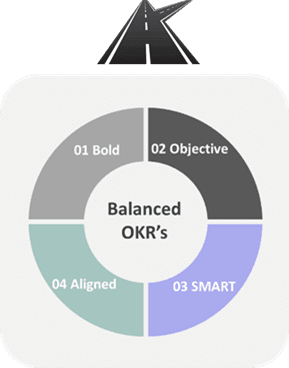
What makes a Good OKR?
Bold: Effective OKRs represent meaningful change, improvement, and growth. OKR’s outline priorities for the next 30-90 days.
Objective: Effective Objectives are meaningful, audacious and inspiring.
Effective Key Results: Specific and timebound, aggressive and realistic, measurable and verifiable.
Aligned: Organisational OKR’s should cascade to teams and individuals.
What is a KPI?
Key Performance Indicators (KPIs) are used to evaluate performance over time for an organization, individual, program, project, action, etc. While you may have some outliers, these indicators are often measured against targets.
We highly recommend you make your KPIs measurable. Adding quantitative value makes it easier to provide context and compare performance for whatever you’re measuring. Creating qualitative KPIs is possible, but not advisable because this structure can lead to confusion and subjective interpretations of data.
What makes a good KPI?
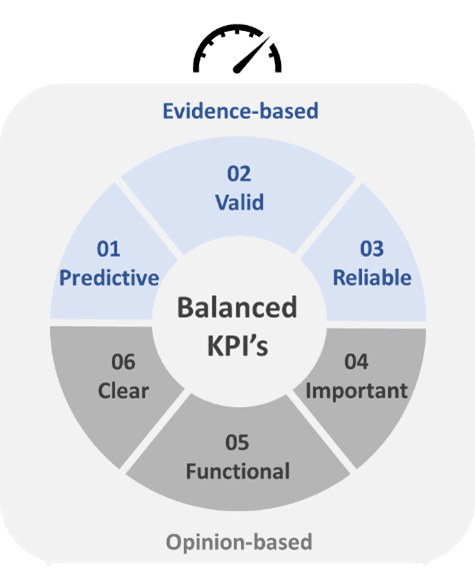
Good KPI combine a balanced approach to include both Evidence-Based and Opinion-Based metrics:
Predictive: Accurately forecasts the future.
Valid: Measures what you intended, statistically meaningful.
Important: Directly reflects an outcome that matters.
Functional: Used to inform operational and strategic risk. Balances compliance vs performance.
Clear: Understood and easily communicated.
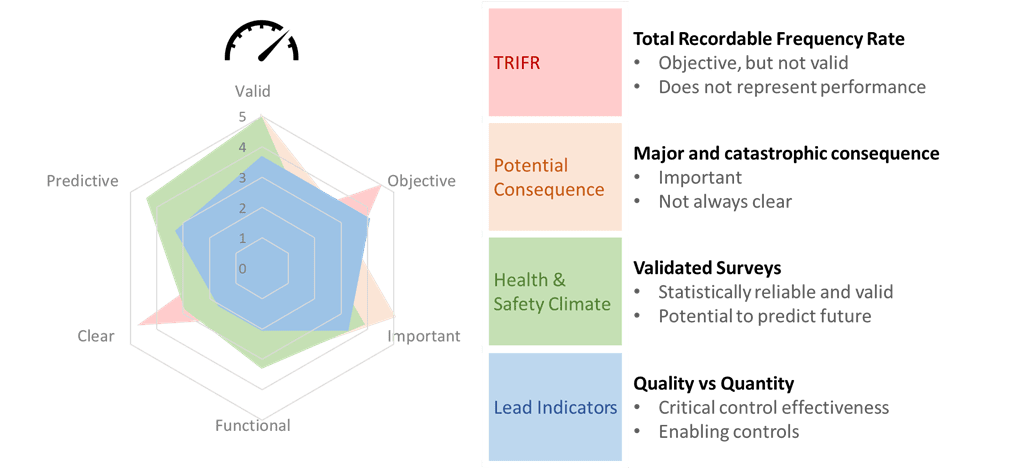
What makes a good health & safety KPI?
When selecting the right KPI, it’s important get the balance right. Examples of KPI’s are outlined below:
A balanced approach to KPI’s
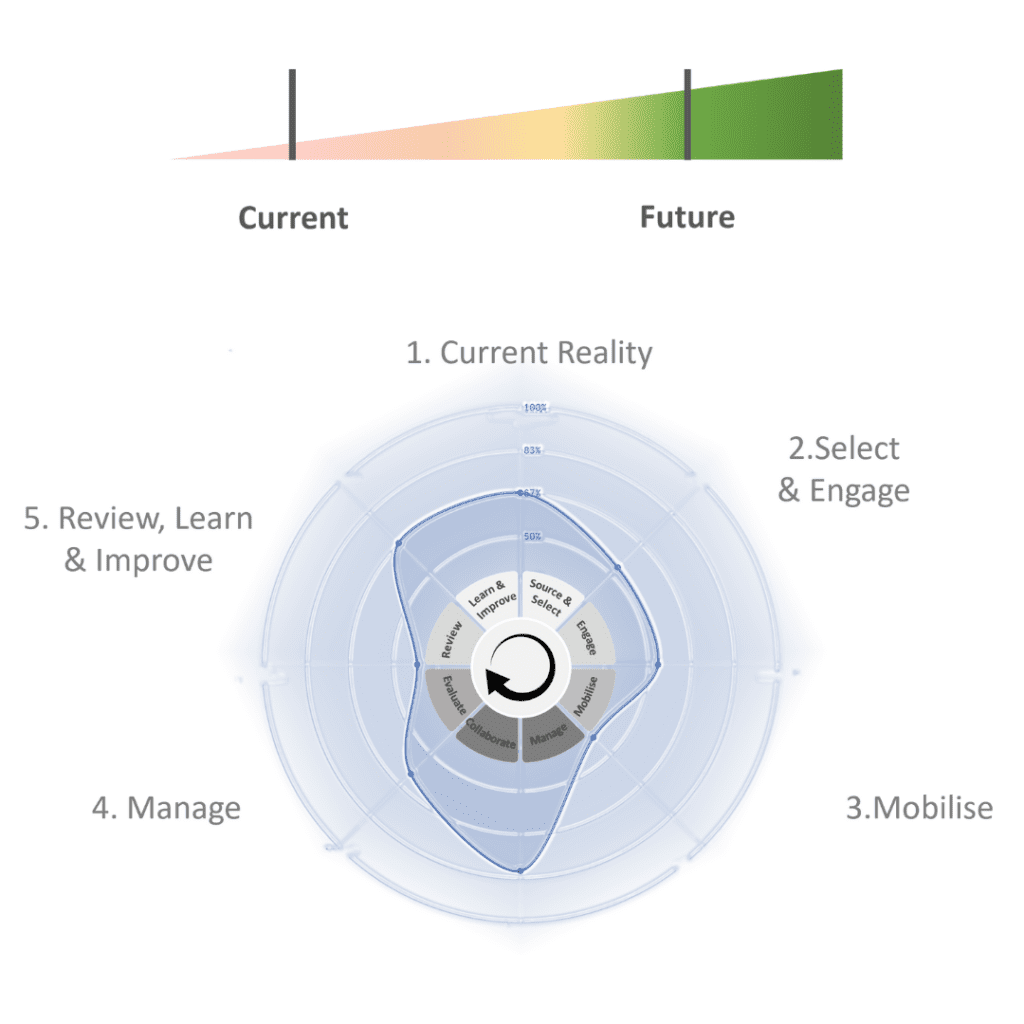
Tailoring metrics to suit your organisations maturity
Executing the Strategy
Developing measures for success with OKR’s and KPI’s is an important step, but only one component to develop and deploy an effective strategy. To get started, refer to some additional resources below:
If you need some guidance on developing and deploying an effective strategy, contact us today.
Download our OKR Template
FEFO Consulting recently is introducing new contractor safety assurance services to assist clients with ensuring effective procurement of services. To support these services, we are leading a 5-part webinar series on contractor safety in partnership with myosh.
How much influence and control is reasonable when managing contractor health and safety? Managing health and safety when contracting is not black and white. In fact, there are different risk profiles, different contract types and stakeholder requirements.
This webinar will outline obligations, threats and opportunities when managing contractor health and safety. Contractor management can be complex and a burden for multiple stakeholders if not deployed effectively. Conversely, simplifying contractor management based on risk can provide huge amounts of opportunity to reduce compliance burdens, effectively engage stakeholders, and build high-performing cultures.
Engineer and contractor shaking hands success of the project work together.
1. Selecting & Engaging Contractors
This webinar is Part 1 of 5 and will provide considerations when selecting and engaging contractors. A practical case study on considerations to get started. Join Mark Wright and Ben Kirkbride.
Key takeaways: • Segmenting contractors • Selecting: Tendering and other sourcing options • Engaging: Pre-qualifying and contract agreements.
A risk-based approach to contractor pre-qualifications
Segmenting Simplify Contractor Safety
2. Mobilising Contractors
This webinar is Part 2 of 5 and will outline methods to engage contractors prior to work commencing to ensure readiness. Join Mark Wright and Laura Blampid from Skout Solutions.
Key takeaways:
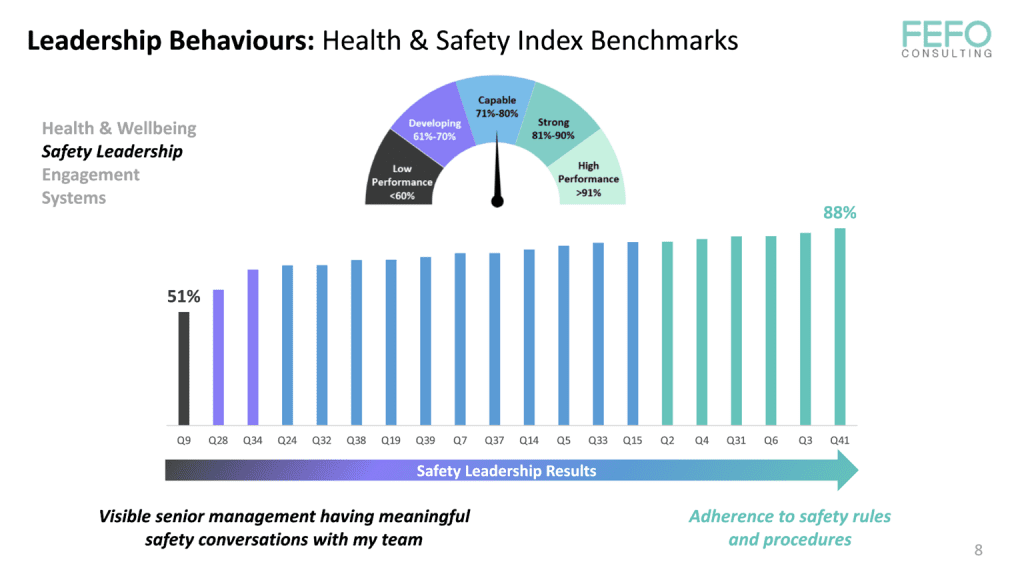
Visible leadership: Visible leadership was the lowest scoring Health and Safety Index Leadership result in 2021. Despite this challenge, effective leadership can create far more value when mobilising contractors compared to focusing too heavily on rules and compliance
Labour hire: Understanding roles of asset owner, principal contractor, and other stakeholders
Work Readiness: Mobilisation activities based on different types of contractors.
3. Managing Contractors
This webinar is Part 3 of 5 and will outline outsourcing solutions for managing short-term high-risk contractors. Join Mark Wright and Alex Sciascia from Ventia.
Key takeaways:
Outsourcing vs Insourcing
Communicating known hazards
Delegations and authorities: e.g. who signs the permit?
This webinar is Part 4 of 5 and will outline how to apply critical control management and examples of how to reflect, learn and improve when working with contractors. Join Mark Wright and Amelia Simony from Spaceframe.
Key takeaways:
Confirming critical controls when working with contractors
WHS Governance and control effectiveness
Methods to collaborate, benchmark performance, learn and improve.
Where to focus contractor safety resources?
Aligning contractor safety assurance with objectives and resources
Using the Health and Safety Index understand contractor performance
5. Contractor Safety Technology
This webinar is Part 5 of 5 and outlined technology options with myosh.
Our Unique Assessment Method
What is your Current vs Desired State?
Not all businesses are created equal. Different industry, needs, stakeholders and capability. For this reason, we developed a flexible contractor safety assurance method to suit most organisations.
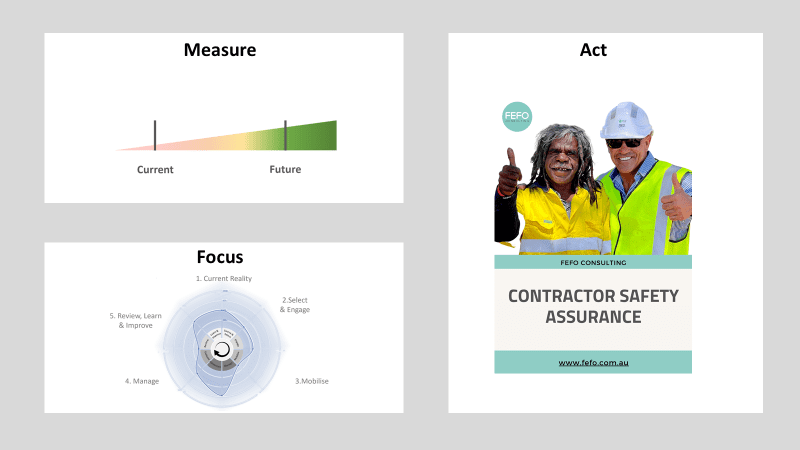
Contractor Safety Assurance
Tips for Contractor Safety
To access our ‘4 Steps to Contractor Safety’, click on the download guide button below:
To learn more from our Contractor Safety case studies, refer to our Success Stories webpage.
Contact us to better understand how you can improve contractor safety.
M: +61 417 570 143
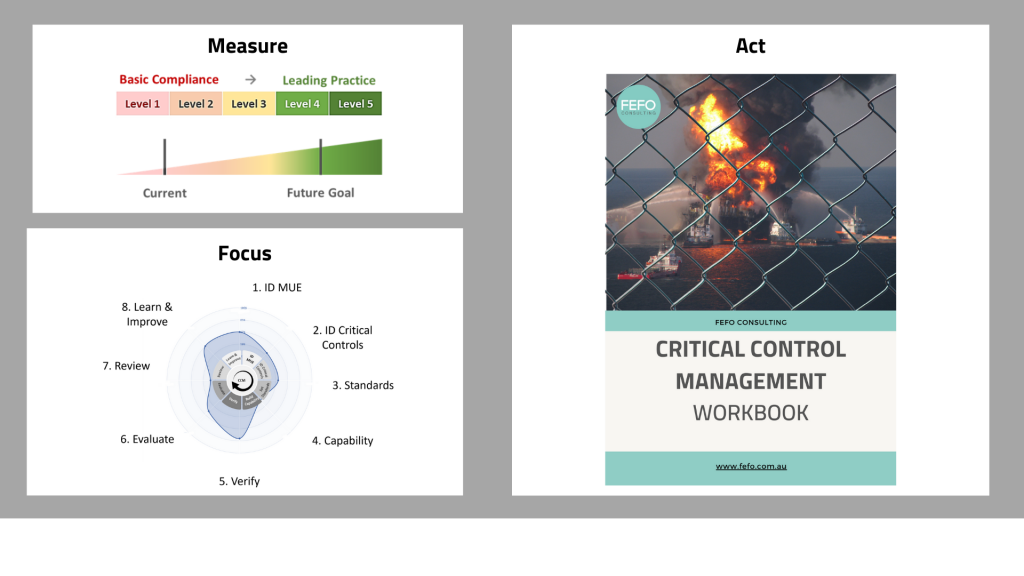
FEFO Consulting recently launched our Critical Control Management (CCM) Workbook, a step-by-step guide to effectively managing critical controls. Our Workbook provide a framework for taking a risk-based approach aligned with international guidance and experience with multiple CCM implementation projects.
This CCM workbook covers:
Material Unwanted Events & Critical Controls
Standards & Capability
Verification & Evaluation
Review, Learn & Improve
Our self-directed CCM Workbook is supported by a simple self-assessment tool providing a selection of 5 different options based on desired maturity levels.
5-Part Webinar Series: Critical Control Management (CCM)
FEFO Consulting is delivering a 5-part series which will provide simple and effective tips on how to deliver a CCM. This will include case studies, shared learning, and guest speakers from several multinational organisations, like Lockheed Martin, Jones Lang LaSalle (JLL), and Natural Resource Australasia.
5-Part Webinar Series
1. Material Unwanted Events (MUE)
This webinar is Part 1 of 5 and provides a simple Introduction to identify Material Unwanted Events (MUE) with high potential consequences. Practical case studies also include tips on mapping major hazards and safety materiality.
Health and Safety Materiality
Measure | Focus | Act
2. Critical Controls
This webinar is Part 2 of 5 and outlined different types of risk analysis option when evaluating Material Unwanted Events (MUE) and methods to identify critical controls. A practical case study will also be provided outlining how to identify critical controls pitfalls.
Pitfalls and Leading Practices
Case Study
3. Critical Control Performance Standards
This webinar is Part 3 of 5 and outlined options for setting critical control performance standards. In additional, practical case studies were provided on setting expectations for assurance activity and attributes of effective critical controls.
70:20:10 Principles
Getting the Basics Right First
4. Critical Control Verification
This webinar is Part 4 of 5 and outlined options for verifying critical controls and evaluating a broader Critical Control Management (CCM) program . In additional, practical case studies were provided by Rebecca Crompton, General Manager, HSE from BSA Ltd.
Checking What Matters!
Supply Chain Critical Controls
Shifting Mindsets
5. Critical Control Performance Mesurement
This webinar is Part 5 of 5 and outlined options for Critical Control Management (CCM) performance measurement. This also included options for a balance scorecard and insights on Environment, Social and Governance (ESG) reporting from Wade Needham, General Manager, EHS, Natural Resources Australasia.
Impact of Poor CCM on Shareholder Value
Lead, Lag and Predictive Indicators
Identifying Specific Behaviours
Our Unique Assessment Method
What is your Current vs Desired State?
Not all businesses are created equal. Different industry, needs, stakeholders and capability. For this reason, we developed a 5 Level maturity assessment approach, allowing organisations to set their own goals.
“Avoid using a sledgehammer to crack a nut!”
Choose your own goals, and we tailor both the assessment and solutions to meet your needs. Based on your results, we provide unique solutions to meet your need.
CCM Assessment
Tips for Critical Control Management (CCM)
Here are a few tips when outsourcing health and safety activity:
Measure – Evaluate current performance based on your unique context (Level 1-5) to understand current vs. desired state
Focus – Understand areas of focus to prioritise what is important
Act –Develop an action plan, identify expertise and resources needed to enable improvements that matter!
To learn more from our CCM case studies, refer to our Success Stories webpage.
Contact us for a free 1-hour discovery session during the month of November 2021 to assist with effective implementation of Critical Control Management (CCM) and avoid unintended consequences.
Is Chronic Unease Healthy?
Having a healthy level of chronic unease can help identify weak danger signals, reduce complacency and improve alertness. Just because a catastrophic event hasn’t happened, doesn’t mean it won’t!
Positive reinforcement of reporting near miss events, acting on weak danger signals and freely communicating good and bad news are all signs of a healthy culture. Examples of weak danger signals could include:
Unexpected maintenance results
Variations from good practice that has become tolerated
Noticing a colleague is distracted while carrying out a critical process
A decision to carry on that we think was made too quickly.
Critical Control Management (CCM)
Critical Control Management (CCM) is an internationally recognised approach1 for organisations to improve the management of potentially fatal and Major Unwanted Events (MUE). In particular, enabling organisation to ensure critical controls are effective.
Clownfish vs Sharks?
What’s an underwater diver’s biggest threat – Hundreds of clownfish or one great white shark attack?
Similarly, CCM focuses on Major Unwanted Events (Shark attack), rather than higher frequency events, that might have a lower consequence (Clownfish)!
Four Steps to Effective Critical Control Management
Identify Material Unwanted Events & Critical Controls: Confirm material risks and critical controls
Set Standards, Build Capability & Capacity: Set critical control expectation and confirm resources
Verify & Evaluate: Set methods to check and provide assurance
Review, Learn & Improve: Review to continually improve
To enable effective CCM outcomes, focus on:
Finding the missing controls that are needed, making note of the ones already in place, e.g., act, objects or systems.
Identifying which of those controls are critical, and
Enabling supervisors and managers to be able to monitor those critical controls effectively
To determine how effective your critical control verification activity is, it requires understanding the right mix of acts, objects and systems. At FEFO Consulting, we believe this means focusing on the critical few by asking questions like:
Are your metrics driving the right behaviour?
Are you overly reliant on injury statistics?
Are you focused on quantity, rather than quality of controls?
Do your operations have a healthy level of chronic unease?
Additional resources can be found by viewing our case studies from BSA and JLL success stories.
If you’re looking to understand how you can effectively verify your own critical controls, have meaningful conversations about safety to prevent major unwanted events and enable improvements in your organisation, contact us today to see how we can help.
Download our Simplified Guide to Critical Control Management
Refer to our Resources page for a complete list of all Downloads
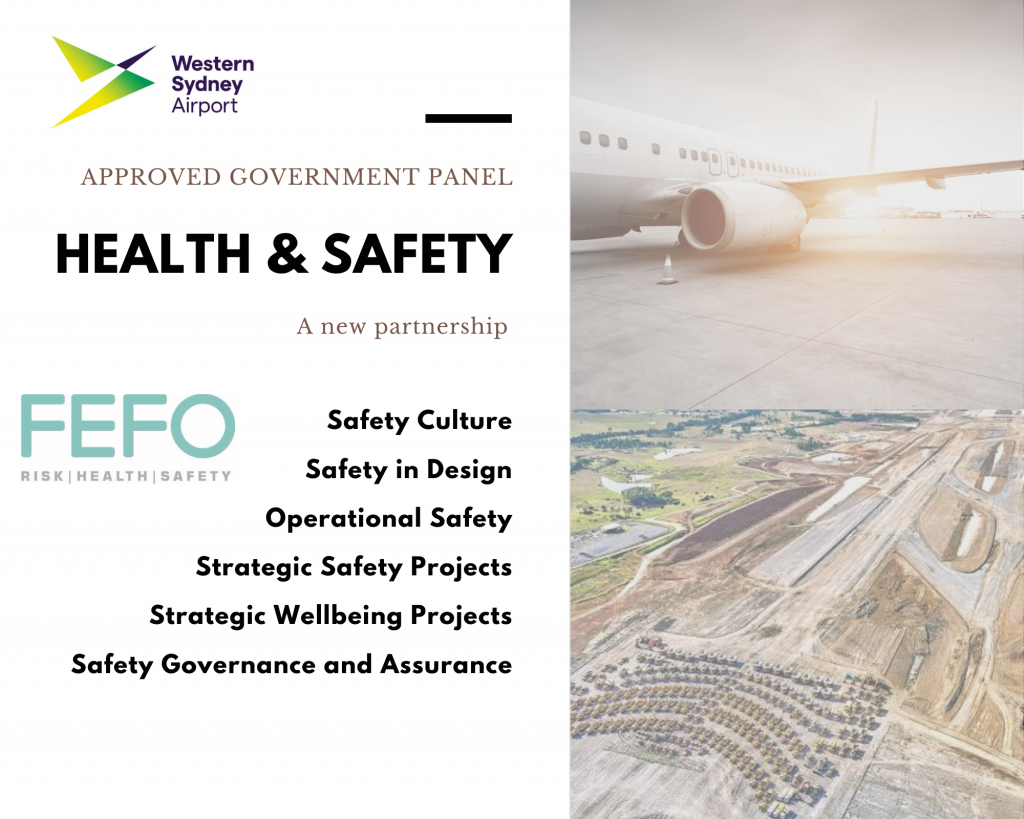
Fefo Consulting is proud to be appointed on the new Western Sydney Airport (WSA) government professional services panel to provide health and safety services. This panel selection further strengthens our risk, health and safety reputation to support the delivering of critical infrastructure.
“Partnering with government to deliver critical infrastructure”
The Fefo Consulting team have a proven track record delivering risk, health and safety services with federal, state and local government. To understand more about our products and services email us or phone +61 417 570 143.
FEFO Consulting recently joined SAP on their Future of Mining podcast to discuss contractor safety. We also covered this topic in a recent workshop organised by the National Safety Council of Australia (NSCA).
What are the challenges when balancing productivity and external workforce safety?
Forbes recently published an article featuring FEFO Consulting, the Health and Safety Index. This article also included SAP Fieldglass research in collaboration with Oxford Economic study showing a massive 42% spend in the workforce on external labour. Not just in one particular industry – across them all. So it’s clearly an industry-wide issue that needed to be addressed.
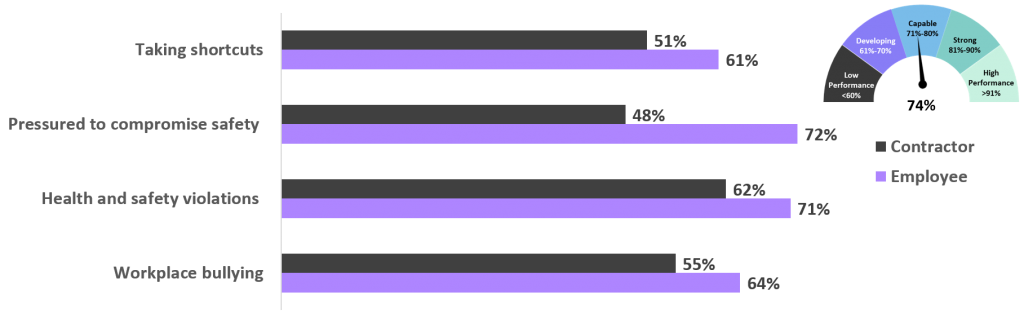
Our own Health and Safety Index confirmed this challenge, by providing benchmarked results on safety, engagement, leadership and systems. We collated this from over 200,000 data point responses in asset intensive companies (based primarily in Australia and New Zealand).
Witnessing colleagues compromise safety – all for the sake of shortcuts – 10% worse with contractors
Feel pressured to compromise safety to complete a job – 24% worse results with contractors
Observed workers violate safety rules – 9% worse with contractors
Bullying – Witnessed bullying to work colleagues –also 9% worse with contractors
In addition, the Australian Council of Superannuation Investors (ACSI) published figures in December 2019 outlining, the percentage of contractor fatalities in ASX 200 companies.
70 percent of fatalities in ASX 200 companies were contractors.
ACSI, December 2019
This is not good enough. But what can be done?
External workforces often consist of short-term labour that’s expected to carry out complex, specialised work at speed as they interact with numerous stakeholders. In driving a high performance culture, don’t put productivity before safety. That leads to a culture of rushing to get the job done, as opposed to looking after your workmates and coming home safely.
Can we minimise risk by simplifying processes and making cultural changes?
As the Principal or Head Contractor, can you treat a small sole trader contractor differently to a large multinational company tendering for a 5-year contract?
The short answer? Yes. The is often a fear of legal breaches leading to over compliance and over the top (OTT) paperwork! For this, we recommend a risk-based approach to managing compliance and also create high performing cultures.
Here are some quick tips:
Identify areas of focus: Targeted approach and prioritise resource
Evaluate threats and opportunities: Understand risks and maximise value
Implement actions: Execute with excellence
Review and improve: Track portfolio performance against initial targets
Where are opportunities to innovate?
The external workforces provides a lot of areas in which we can find innovation opportunities. We urge all organisations to avoid focusing purely on compliance when managing contractors, and think about the numerous ways suppliers can add more value.
“If you want a basic focus on compliance, ask contractor pre-qualification questions that are only based on compliance. If you want to create a collaborative culture of innovation, ask pre-qualification questions to challenge and motivate contractors to add value, i.e. adding health & safety value to both their own and your supply chain.”
Mark Wright
Getting insights right from the source is the best way to improve your workplace safety, and adapt quicker to fast-moving risks and threats.
If you need some guidance in optimising the safety of your contractors, contact us today.
Download our Guide: 4 Steps to Contractor Safety
Do companies focus too much on individuals and lower order controls?
Too often organisations focus on individuals and lower order controls such as training and mindfulness, rather than focusing on job design, job demands and organisational resources.
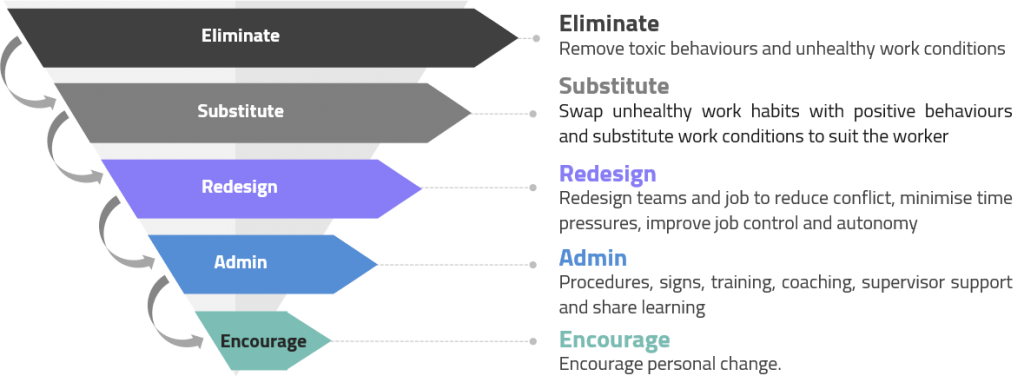
The ‘Hierarchy of Controls Applied to NIOSH Total Worker Health’ provides a conceptual model for prioritising efforts to advance the safety, health, and wellbeing of all workers.
NIOSH1 Total Worker Health Hierarchy of Controls
Manual Handling Analogy: If the job demands of lifting boxes was too difficult, would you:
a) Provided education and tell the work to visit the gym and getter fitter
or
b) Complete an assessment to determine job demands, job resources and apply the hierarchy of controls, e.g. eliminate the load, swap load with a lighter product and / or provide lifting aids.
Health & Wellbeing: Psychosocial hazards are not universally understood and often much harder to evaluate compared to physical safety hazards, e.g. the impact of a heavy box leading to a sprain or strain.
The hierarchy of controls has been a legal requirement for many years. That alone, it not the sole reason to apply the hierarchy of controls to psychosocial risks. If a company can redesign the job demands to match the needs of a worker, it just makes sense.
Realistic time pressures2 are often associated with lower health and wellbeing performance. Understanding both job demands, job resources and effective controls are critical to understanding the impacts on worker health & wellbeing.
Conclusion
Taking a risk based approach to health and wellbeing is a logical, yet sometimes challenging activity to complete effectively. We recommended assessing psychosocial risk using the latest research and expert advice, rather becoming overly reliant on training and other lower order controls. Applying the hierarchy of controls to tasks to job demands, job resources and worker outcomes can reduce risk and provide a positive Return on Investment (ROI)3.
Have you completed a formal assessment to determine the health and wellbeing controls that are relevant to your organisation?
Contact us to learn more:
M: +61 1300 909 649
E: info@fefo.com.au
Source1: Adapted from NIOSH [20160]. Fundamentals of total worker health approaches: essential elements for advancing worker safety, health, and well-being. By Lee MP, Hudson H, Richards R, Chang CC, Chosewood LC, Schill AL, on behalf of the NIOSH Office for Total Worker Health. Cincinnati, OH: U.S. Department of Health and Human Services, Centers for Disease Control and Prevention, National Institute for Occupational Safety and Health, DHHS (NIOSH) Publication No. 2017-112.
Source3: Creating a mentally healthy workplace: Return on investment analysis, PwC
Don’t miss out on our Newsletters!
Sign up for industry leading news, case studies and informative videos…
It’s been a challenging year for many and also a year that risk, health and safety management has never been more critical. Thank you for your support. With the support of our clients, partners and expert team, in 2020 the FEFO team:
Partnered with 30+ new customers
Launched new leadership, health and wellbeing programs to an international audience
Received 120,000+ Health & Safety Index responses
Was humbled to be a Finalist in Australian Small Business Champion Awards.
Psychological safety & high performance: go hand in hand
Managing the risk, health and safety of an organisation goes well beyond the physical.
“There’s no team without trust,” says Paul Santagata, Head of Industry at Google. The results of the tech giant’s massive two-year study on team performance, revealed that the highest-performing teams have one thing in common: psychological safety, the belief that you won’t be punished when you make a mistake.” Harvard Business Review
FEFO’s Mental Health & Wellbeing team specialise in helping organisations apply practical research and informed tools to achieve psychological safety. Hear from Sally Boucher, FEFO Senior Consultant, in this 1 minute video touching on psychological safety and how to build an effective team culture.
Client Review:
“The FEFO Mental Health & Wellbeing training facilitated by Kate and Sally provided excellent, valuable information. It was presented clearly and in an appealing format and we received lots of positive feedback. 94% of attendees surveyed recommended their colleagues to attend the Mental Health & Wellbeing training.”
Caitlin Walkenhorst Asia Pacific ESH Senior Manager Lockheed Martin
Working in Partnership: keeping people safe
FEFO teamed up with Disaster Relief Australia, a not-for-profit organisation supporting communities devastated by disaster, to create a new Workplace Health & Safety Manual.
The Disaster Relief Australia team and all the selfless volunteers do an amazing job for communities throughout Australia. Watch this 30 second Disaster Recover Support video created by JMAcreative to find out more about our collaboration.
Case Study
“Culture eats strategy for breakfast” -Peter Buckley
Building Capability: Facilitating nine interactive workshops across New Zealand
Sustaining: Helping leaders with new learnings and continuous improvement.
Find out more by reading the brief FEFO case study Building an Effective Culture. Be sure to view the video featuring Kate Power, FEFO Director, by clicking the ‘What’s in it for you’ link contained within the article.
Connect with us
We’d love you to jump on-board and join our LinkedIn community. You can expect:
Our take on the latest risk, health and safety industry news
Top tips from our expert team
Case studies showcasing real risk, health and safety challenges and solutions
Brief videos with helpful insights
Events to participate in, both face-to-face and virtual
Senior Experienced and Ready to Partner
The FEFO team is agile and experienced, with a small number of hand-picked, senior-level risk, health and safety experts at the helm. Find out more about our seasoned team, their specialist expertise and our research-backed approach.