
FEFO Consulting

TRIFR Alternatives to Measure Health & Safety: Enabling Effective Assurance and Due Diligence 

FEFO Consulting Insights  Mark Wright of FEFO Consulting recently presented at the NSCA Foundation conference in Perth and posed a question that stopped the room:  “Are First Aid and Medical Treatment injury classifications a severity measure, or a method of treatment?” 🤔  First Aid Injuries (FAI) and Medical Treatment Injuries (MTI) tell us how an injury was treated — not how […]

FEFO Consulting Insights 

Mark Wright of FEFO Consulting recently presented at the NSCA Foundation conference in Perth and posed a question that stopped the room: 

“Are First Aid and Medical Treatment injury classifications a severity measure, or a method of treatment?” 🤔 

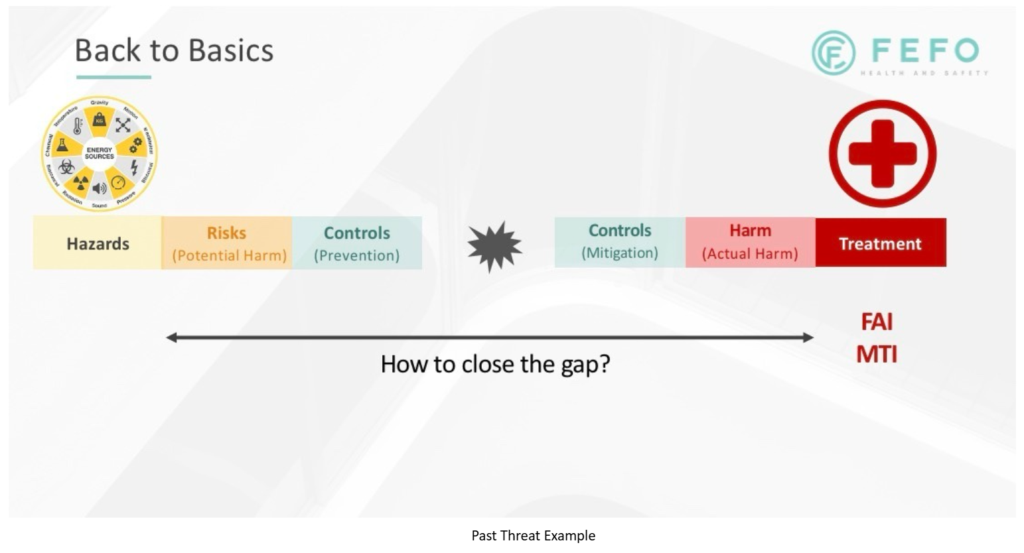
First Aid Injuries (FAI) and Medical Treatment Injuries (MTI) tell us how an injury was treated — not how severe it truly was. With 95% of conference participants confirming they still report on these classifications, the industry has a real opportunity to modernise its metrics and focus on indicators that actually drive safer outcomes. 

Why organisations are moving away from traditional metrics 

Many organisations are re-thinking their reliance on hazard reporting, counting activity, and injury frequency rates as the primary measures of health and safety performance. These traditional approaches carry a number of limitations: 

So, what are the alternatives? 

To close the gap, many organisations are transitioning to three key measurement options: 

  1. Actual vs potential consequence 
  2. Control effectiveness 
  3. Survey diagnostics 

Let’s explore all three. 

1. Actual vs potential consequence 

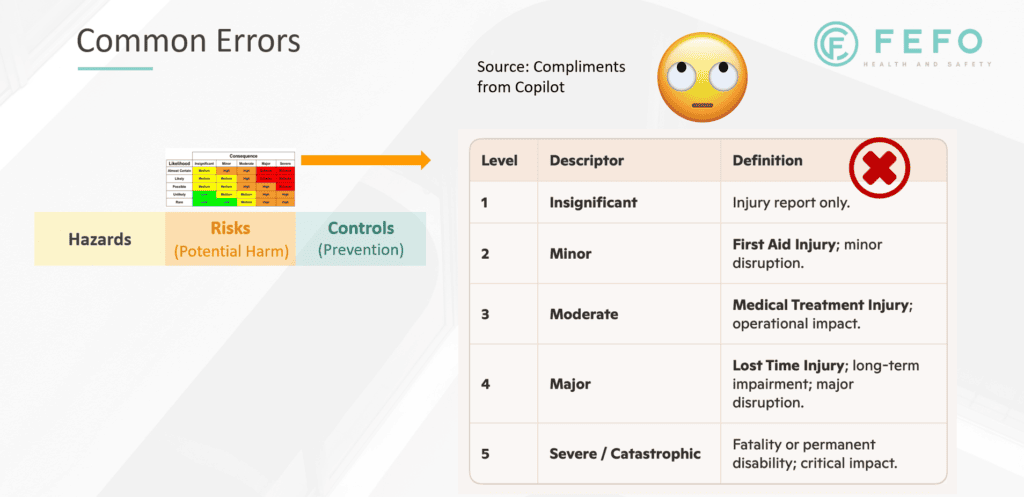
One of the biggest factors limiting organisations from reporting on actual and potential consequence is a lack of clear definition. Many risk matrices use FAI and MTI to define severity of consequence. But FAI and MTI are methods of treatment, not levels of harm. You can have no FAI or MTI and still have a high-potential near miss. The difference between an FAI, an MTI and a Lost Time Injury (LTI) is often down to luck, or simply the way an injury is “managed”. 

We recommend defining levels of consequence based on maximum reasonable harm. This enables a more consistent and relevant way of reporting actual and potential harm across health, safety, environmental and psychosocial categories. It highlights how close an organisation has come to a catastrophic event, and prompts discussion on the areas that really matter for learning. (See the case study below.) 

2. Control effectiveness 

A progression from reporting actual or potential events is to become more proactive and focus on the effectiveness of controls. 

We recommend establishing the building blocks of an effective Critical Risk Program to enable meaningful measurement of control effectiveness. Learn more about our approach: Critical Risk Controls

3. Survey diagnostics 

Statistically reliable survey diagnostics enable feedback at scale and robust benchmarks — allowing organisations to confidently compare performance over time, against external organisations in similar industries, and internally across demographics such as position, age, gender, location and business unit. 

Learn more about our approach: Health & Safety DX Diagnostic

Case study: what the data revealed 

FEFO Consulting recently completed a detailed review of health and safety performance measurement for an organisation operating across Australia and New Zealand. 

The purpose of the review was to evaluate the organisation’s current Board-level health and safety performance reporting and provide recommendations for improvement. The organisation was using injury frequency rates and hazard reporting as its primary mechanisms for reporting on health and safety performance. While many people recognised the limitations of this approach, there was hesitance to shift without viable alternatives. Ironically, the organisation was already capturing both actual and potential consequence data from incident reports — it just wasn’t being interpreted or included in Board performance reports. 

Following a detailed analysis of the data, the case for change was compelling. 

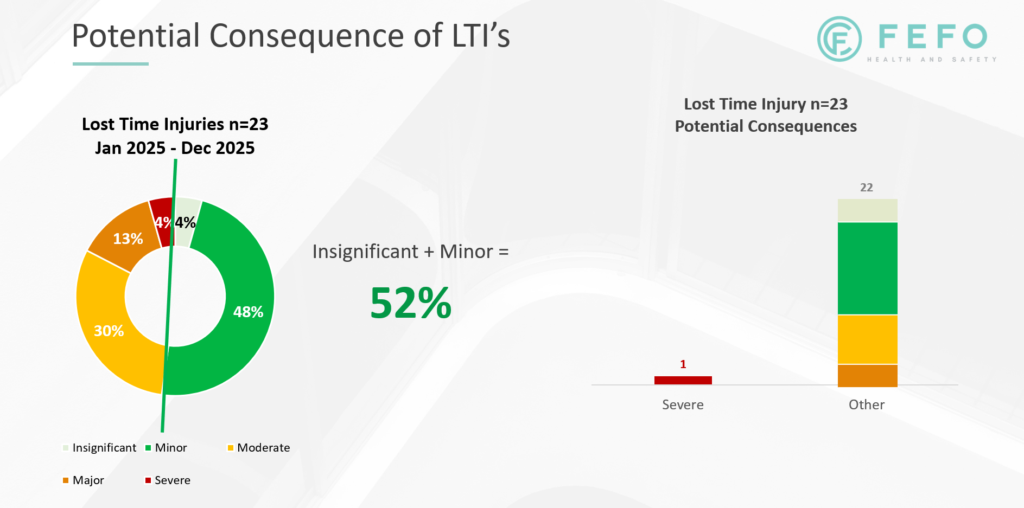
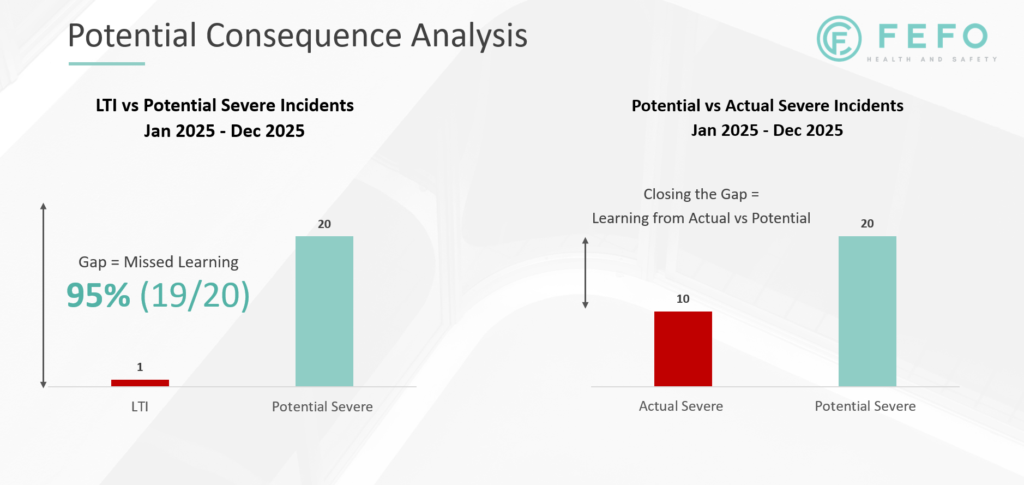
When evaluating annual Lost Time Injury (LTI) data, the review found: 

This didn’t just highlight a missed opportunity to learn from actual and potential severe consequence events — it also created governance and compliance risk, with Board members and Officers unable to demonstrate effective due diligence. 

In summary 

Many organisations would benefit from moving away from hazard reporting, counting activity, and injury frequency rates as their primary safety metrics. Closing the gap between current and desired performance measurement requires the right foundational systems — systems that enable effective learning, better decision-making, stronger governance, robust due diligence, and ultimately, a high-performance safety culture. 

Ready to modernise how your organisation measures and reports on safety performance? 

Explore our Critical Risk Controls service or take our Health & Safety DX Diagnostic

Share this post

What we do

We help organisations simplify critical aspects of health and safety by strengthening controls and enabling high performance.