FEFO Consulting

HECA: Planning and Verifying Critical Controls 

Critical controls work best when they are chosen where the work happens. Yet one of the most common pitfalls in critical risk management is completing bow-tie risk analysis behind a desk in an office, rather than onsite where the work is actually done. High-Energy Controls Assessments (HECA) give planners a simple, evidence-based way to close […]

Critical controls work best when they are chosen where the work happens. Yet one of the most common pitfalls in critical risk management is completing bow-tie risk analysis behind a desk in an office, rather than onsite where the work is actually done.

High-Energy Controls Assessments (HECA) give planners a simple, evidence-based way to close that gap. 

Why use HECA?

Too often, bow-ties and critical control lists are built in an office, isolated from the actual work.

The result is a control list that looks complete on paper but misses what crews face on site: a changed layout, a different item of plant, or overhead power lines that were never on the drawing. 

Research backs this up. HECA was developed by the Construction Safety Research Alliance (CSRA) at the University of Colorado Boulder to measure whether every high-energy hazard on a job has a direct control in place. CSRA’s research found that around 40 per cent of high-energy hazards still lack adequate safeguards, which means a single mistake on those tasks could be fatal. 

Identifying high-energy hazards, Material Unwanted Events (MUE) and critical controls are important planning elements when managing critical risks. HECA builds them into planning, and it rests on three ideas: 

HECA in four simple steps 

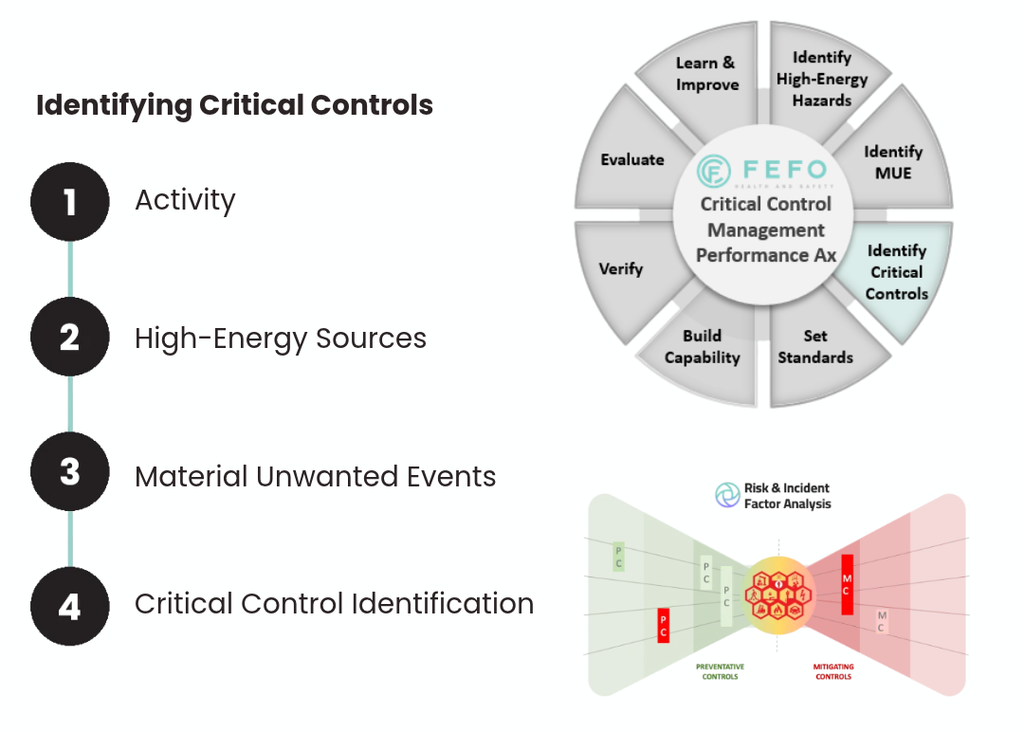
HECA moves from the task to the controls in four steps, ending with a review that happens both in the office and on site. 

  1. Activity. Start with the task being planned, such as driving, lifting, hot work, working at height or working near energised equipment. 
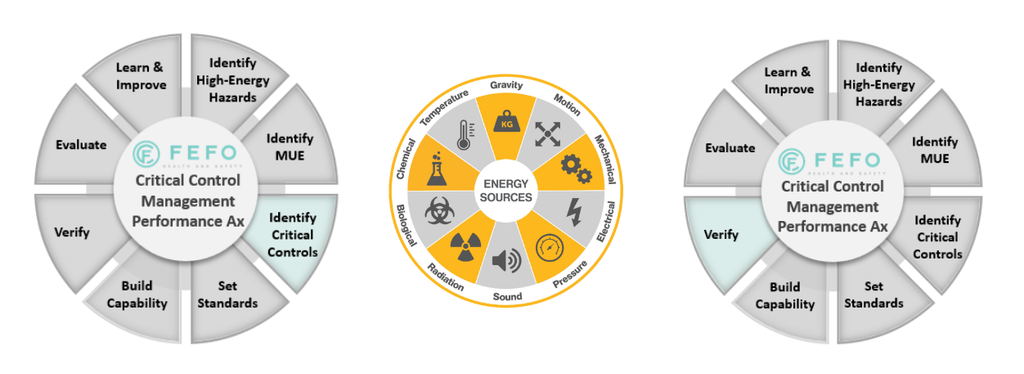
  1. High-energy sources. Screen the activity against the energy wheel: gravity, mechanical, motion, electrical, pressure, sound, radiation, biological, chemical and temperature. Hazards that carry enough energy to cause a fatality are flagged as high-energy. 
  1. Material Unwanted Events (MUE). For each high-energy source, name the event that would cause a fatality or catastrophic outcome if control is lost. 
  1. Critical control identification. Identify the controls that stand between the energy and the event, using office and onsite HECA reviews together. Preventative controls act before the loss of control; mitigating controls limit the consequences after it. 

HECA planning and verification 

HECA is used twice on the same task: once to plan the work, and again to verify that the plan holds up when the work starts. 

Planning. Before work begins, the team runs the four steps for each high-risk task. They record the high-energy sources and MUEs, and nominate the critical controls that must be in place before anyone is exposed. That list then feeds the work pack, permit, SWMS or JSEA, so the controls are built into how the job is set up rather than added at the end. 

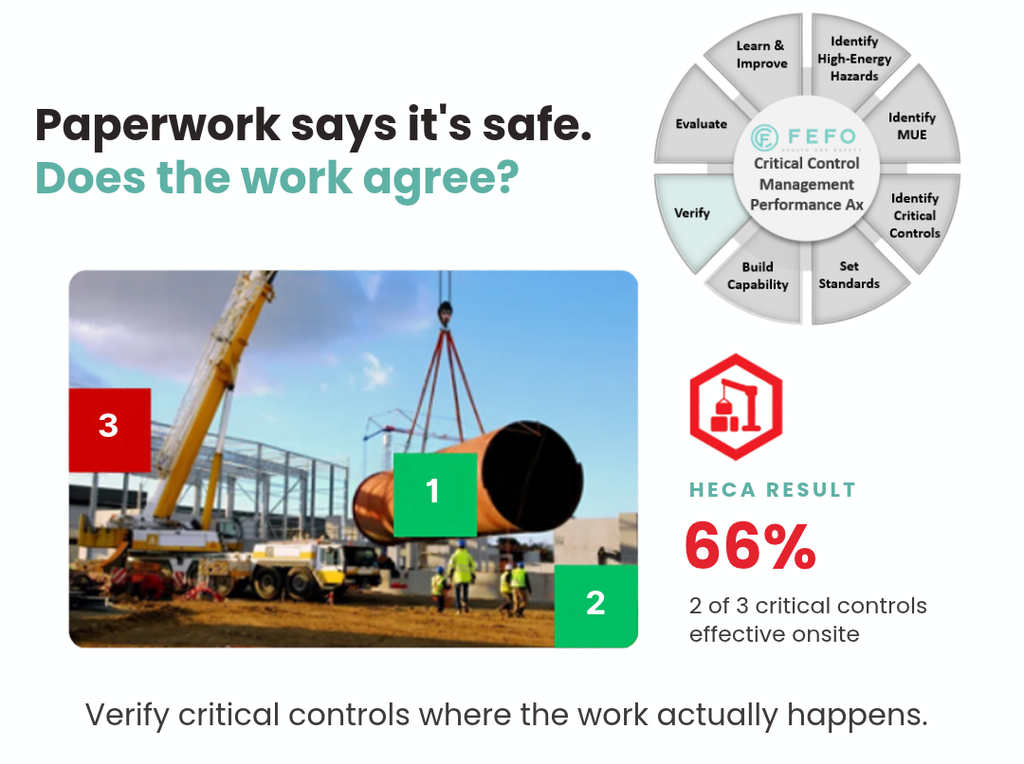
Verification. At the point of work, each nominated control is checked to confirm it is actually present, effective and working as intended. Following the CSRA approach, every control is tested against three questions: 

Controls that pass all three are direct controls. Training, signage, toolbox talks and supervision still support the work, but they should not be the only thing standing between a person and a fatal event. 

The results can be expressed as a simple HECA score: the percentage of high-energy hazards observed with a direct control in place. Tracked over time, it becomes a leading indicator that shows where controls are strong and where the next serious incident could come from, instead of waiting for injury rates to tell the story. 

HECA field vs desktop assessments 

Both types of assessment have a place. Problems start when the desktop version is treated as the finished product. 

The strongest approach combines the two.

Use the desktop assessment to prepare, then take it into the field and test it with the people who will do the work. Where the field and desktop findings differ, the field result wins, and the plan is updated before work proceeds. 

Getting started with HECA

Pick one upcoming high-risk task and run the four steps with the people who will do the work. Compare what the office team lists with what the crew sees on site, and plan around the controls that matter most. 

To bring HECA to life and have an expert complete risk analysis, planning and verification in the field, contact FEFO Consulting on +61 1300 909 649.

Share this post

What we do

We help organisations simplify critical aspects of health and safety by strengthening controls and enabling high performance.