
FEFO Consulting

Is ISO 45001 Certification a Relevant Contractor Prequalification Criteria?

ISO 45001 certification is often the default gatekeeper in contractor prequalification. No certificate, no invitation to tender. It’s treated as a proxy for health & safety performance — a box that, once ticked, tells a head contractor everything they need to know. Whilst pre-qualification is only one small step in the entire contractor lifecycle, it […]

ISO 45001 certification is often the default gatekeeper in contractor prequalification. No certificate, no invitation to tender. It’s treated as a proxy for health & safety performance — a box that, once ticked, tells a head contractor everything they need to know.

Whilst pre-qualification is only one small step in the entire contractor lifecycle, it is often one of the most important and misunderstood practices.

But does it?

The ISO Evidence Problem

ISO 45001 certification tells you a contractor has documented a health & safety management system that meets a standard, verified by an Auditor. What it doesn’t tell you is the capability of the Auditor who verified the system, and other health & safety practices that add value to your company and project.

That gap matters in practice. Certification can exclude genuinely capable contract  ors who simply can’t absorb the cost and administrative overhead of certification or choose to avoid the certification process. Furthermore, relying on certification body, does not necessarily fulfil your own due diligence obligations – both legal and moral.

The Injury Frequency Problem

Alongside ISO certification, many prequalification processes rely heavily on requesting injury frequency rates, i.e. TRIFR, LTIFR, and similar as a proxy for health & safety performance.

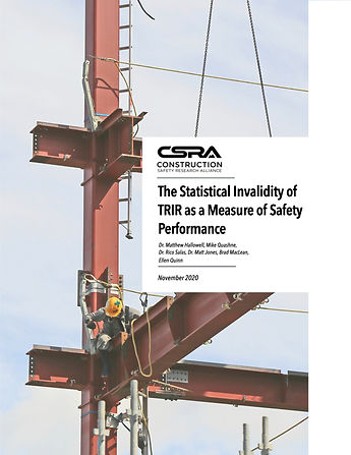
The research1 doesn’t support this as strongly as the industry assumes. A recent analysis of prequalification surveys used across the construction industry found that the overwhelming majority still default to lagging indicators like injury rates, while the elements genuinely predictive of safety performance — critical control systems, statically reliable survey diagnostics, and other value add interventions were largely absent.

There’s a practical problem here too. Injury frequency rates are volatile at low exposure hours. A single incident can swing a small or medium contractor’s rate dramatically, making the metric more a function of statistical noise and reporting culture than genuine risk control. Contractors who suppress or reclassify incidents can look safer on paper than contractors who report transparently. Using injury frequency as a prequalification gate rewards the wrong behaviour.

For more information on measuring health & safety performance, refer to our blog “TRIFR Alternatives to Measure Health & Safety: Enabling High Performance.” 

The Pre-Qualification Document Review Problem

There’s a third layer of waste that compounds the first two: the hours principal head contractors and their WHS teams spend combing through a contractor’s safety management system documents, work method statements, and individual worker licences and tickets at the prequalification stage. Holding and maintaining those credentials is core business for the contractor, not for the party reviewing them. Alternatively, reasonably relying on contractors is fair, if other checks and balances are robust across the entire contractor lifecycle. 

That reallocation matters because the hours saved at the desk are hours that can be redirected downstream, to where risk plays out, i.e. verifying that critical controls are working as intended on site. Reviewing the content of contractor documents is not only resource intensive, but there are also more effective ways to verify contractor capabilities, while reasonably relying on their expertise.

To compound this burden on the contractor, a one size fits all approach often creates safety clutter – often a  burden for all involved, e.g. asking the same questions for  labour hire company, facilities management trade contractors and large Principal Contractor regardless of the risk can be problematic. For more information refer to our blog on Contractor Spans of Controls.

A Better Start : Engage by Separating the Gate from the Score

Part of the confusion in the industry comes from blurring two fundamentally different decisions:

  • Prequalification is a threshold decision — is this contractor even eligible to be considered? It should be binary: pass, pass with additional controls or fail. Not a one size fits all, but an approach based on risk that reduces clutter and is targeted. 
  • Tendering is a comparative decision — how does this contractor’s capability stack up against others who’ve already cleared the gate?

Treating certification, injury rates and piles of paperwork as prequalification criteria conflates these two. It turns a pass/fail gate into a de facto scoring mechanism, and it does so by using very weak indicators.

Tier One: The Gate

Prequalification should test genuine non-negotiables — the things a project cannot proceed without, regardless of how good a contractor otherwise looks.

Current insurances, statutory company licensing, and regulatory registrations, confirming safety systems to demonstrate duties sit here. Certification, if referenced at all, becomes one of several indicators to demonstrate baseline compliance — not the whole assessment.

Tier Two: The Tender

This is where genuine differentiation should happen — and where the evaluation should shift from inputs to outcomes. Rather than asking whether a contractor has a policy, a plan, or a certificate, tender evaluation should test what a contractor can demonstrate to add value.

Capability and effectiveness, not paperwork, is what should differentiate contractors at this stage.

Rethinking the Framework

None of this means certification or safety statistics are worthless — they’re just poorly placed to be used as a contractor prequalification decision.

The question worth asking isn’t whether a contractor is certified or what their injury rate says. It’s whether your prequalification and tender process is built to identify contractors who demonstrate effective outcomes and value to your project and business.

If your current prequalification criteria is a one-size-fits all and is asking for ISO certification, injury data and uploading irrelevant paperwork, it might be time to rethink what you’re really evaluating.

Where to Start

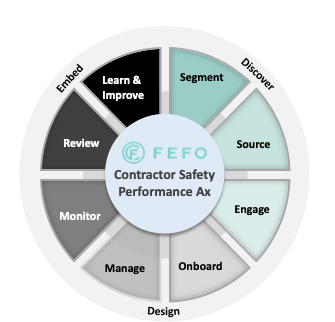
FEFO’s Contractor Safety Performance Assessment does exactly that — it helps organisations benchmark your current contractor safety management practices to create a logical case for change and track improvement over time.

Get in touch with FEFO Consulting to find out how your contractor prequalification and tender process really stacks up, and how it compares to an effective risk-based approach to help declutter.

References:

1. Liu, K.-H., Tessler, J., Murphy, L. A., Chang, C.-C., & Dennerlein, J. T. (2018). The gap between tools and best practice: An analysis of safety prequalification surveys in the construction industry. NEW SOLUTIONS: A Journal of Environmental and Occupational Health Policy, 28(4), 683–703. https://doi.org/10.1177/1048291118813583

Share this post

What we do

We help organisations simplify critical aspects of health and safety by strengthening controls and enabling high performance.