Practical strategies for builders, principal contractors, and project teams to gain and retain accreditation, to strengthen controls, and improve safety outcomes across construction projects. Demonstrating a strong high performance culture and compliance is essential for winning work, maintaining trusted client relationships, and protecting workers across every stage of a project lifecycle. For builders, principal contractors, and subcontractors working across federally funded commercial, civil, infrastructure, and government projects, gaining and retaining Federal Safety Commissioner (FSC) accreditation is an important step in demonstrating that […]
Practical strategies for builders, principal contractors, and project teams to gain and retain accreditation, to strengthen controls, and improve safety outcomes across construction projects.
Demonstrating a strong high performance culture and compliance is essential for winning work, maintaining trusted client relationships, and protecting workers across every stage of a project lifecycle. For builders, principal contractors, and subcontractors working across federally funded commercial, civil, infrastructure, and government projects, gaining and retaining Federal Safety Commissioner (FSC) accreditation is an important step in demonstrating that commitment.
The FSC standard is well recognised to much higher, more prescriptive and often more challenging to achieve compared to ISO certification and other industry accreditations. However, gaining accreditation is only part of the journey. Retaining FSC accreditation requires ongoing effort, smart processes, and a proactive approach to safety management.
In our latest HammerTech webinar, we explored practical steps construction businesses and project teams can take not only to initially gain FSC accreditation but also retain accreditation with successful FSC surveillance audits.
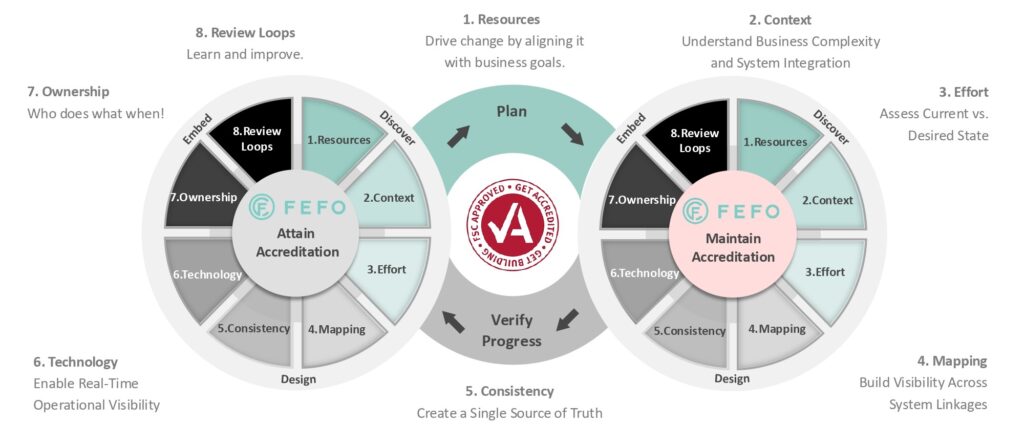
Here are the eight tips discussed during the session, which align with our proven FSC methodology to discover, design and embed an approach specific to your business needs.
DISCOVER
1. Resources: Build a Genuine Case for Change
One of the biggest barriers to maintaining FSC accreditation is treating it as a short-term project rather than a longer-term strategy.
High-performing organisations begin by establishing a clear case for change that aligns accreditation with broader business objectives.
This stage is not simply about assigning safety responsibilities. It is about creating executive ownership, governance structures, decision-making clarity, and operational accountability across the business.
FSC accreditation is not easy. Successful organisations establish:
Current vs desired state understanding
Governance arrangements
Executive sponsorship and right resources
Operational ownership
Timing to suit business needs
Measurable performance objectives
Strategic alignment between projects and leadership.
Without governance alignment, accreditation often becomes fragmented, reactive, and difficult to sustain at scale.
2. Context: Understand Business Complexity and System Integration
Many organisations attempt to implement FSC requirements without fully understanding how their health and safety management systems can simply integrate with different business disciplines, e.g. quality, and environmental systems, operational systems interact across projects, contractors, technologies, and business support functions.
The goal is not to create additional layers of administration. Understanding the level of system integration, the hierarchy of documents, multiple certifications, legislation and other system design elements is important to create a sustainable system that works for your business.
One of FEFO’s core methodologies is helping organisations understand the gap between current and future state.
Truly understanding the nature of gaps, the best solution options, benefits, trade-offs and effort required to resolve is critical. This does not always mean a detailed and expensive gap analysis to understand current vs. future state – contact us to understand more.
Often organisations aim to minimise organisational change. Making the determination between refining the existing system (renovation) vs. starting a fresh (knockdown rebuild) vs. a hybrid solution takes experience and deep expertise.
Confirming the right design options, effort and resources is an important investment decision, and effective choices can only be made with the right information to inform the best decision for your organisation.
4. Mapping: Build Visibility Across System Linkages
One of the most common causes of audit findings is disconnected systems operating independently across the business. Our proven methodologies not only map proposed management systems to external FSC, ISO and other requirements, but also include internal system mapping. This helps with both design and management of change. Using a system map to understand the knock on effect of any change is extremely beneficial.
This mapping process helps organisations:
Identify duplication
Reduce contradictions
Improve accountability
Clarify ownership
Align with FSC audit criteria
Improve operational consistency.
Reduce contradictions
When systems are connected properly, accreditation becomes significantly easier to maintain because evidence pathways are already embedded, tracking and managing change is made easy.
5. Consistency: Create a Single Source of Truth
A system that is designed to have the same requirement or system in multiple places can lead to a duplication of effort and a higher risk of inconsistencies. This often creates operational confusion, conflicting expectations, and compliance risk. More importantly, in high risk situations this can lead to serious harm, catastrophic events and fatalities if gone unchecked.
High-performing organisations simplify complexity by creating a single source of truth, e.g.
Standardised workflows
Centralised documentation
Shared operational standards
Consistent terminology
Clear version control
Unified reporting systems.
Most importantly, it reduces the administrative friction that often overwhelms operational teams and creates unintended consequences.
Technology is an amazing enabler if used effectively. One common pitfall is jumping to solution mode expecting technology to solve a problem without first understanding requirements and establishing foundational processes. Once the building blocks are effectively established, technology is a great wat to automate, digitise paperwork, improve visibility, decision-making, verification, and operational responsiveness.
Modern construction businesses are increasingly leveraging technologies such as:
HammerTech
Digital permit systems
Real-time workforce onboarding
CCTV and remote verification systems
Mobile inspections
Live compliance dashboards
Digital assurance workflows
Integrated reporting platforms
The strongest organisations use technology to shift from being reactive to enabling predictive operational insights. Technology becomes particularly powerful when integrated into broader operational and assurance systems rather than functioning as isolated compliance tools.
Many accreditation systems fail because ownership remains isolated within safety teams rather than embedded across operations. Common pitfalls include:
Assigning responsibility to:
The company, rather than a position, e.g. ACME Company is responsible for xyz….leads to ambiguity
Multiple positions, rather than one position e.g. Supervisor / Project Manager….this creates potential confusion finger pointing!
Not defining responsibility art all! e.g. overreliance of informal arrangements and luck.
Long-term success requires responsibilities to be clearly defined at all levels of the organisation for both one-off and recurring activities. This often includes three or four lines of defence to enable effective assurance.
This creates stronger engagement, more sustainable systems, improved ownership less confusion and accountability.
8. Review Loops: Reflect, Learn and Improve
The most mature organisations do not wait for audits, incidents, or failures before improving systems. They create structured review loops that continuously:
Collect feedback
Verify effectiveness
Monitor performance
Identify weak signals
Close actions
Improve controls
Refine systems.
Continuous improvement is one of the strongest indicators of operational maturity and long-term accreditation sustainability. Contact us for simple tips on building review loops with effective closure for improvement.
In Summary
If managed well, FSC accreditation becomes not just a compliance burden – but a byproduct of a mature, connected, and continuously improving operational environment. This not only improves health and safety outcomes but also creates amazing commercial opportunities!
Refer to our Resources page for a complete list of all Downloads