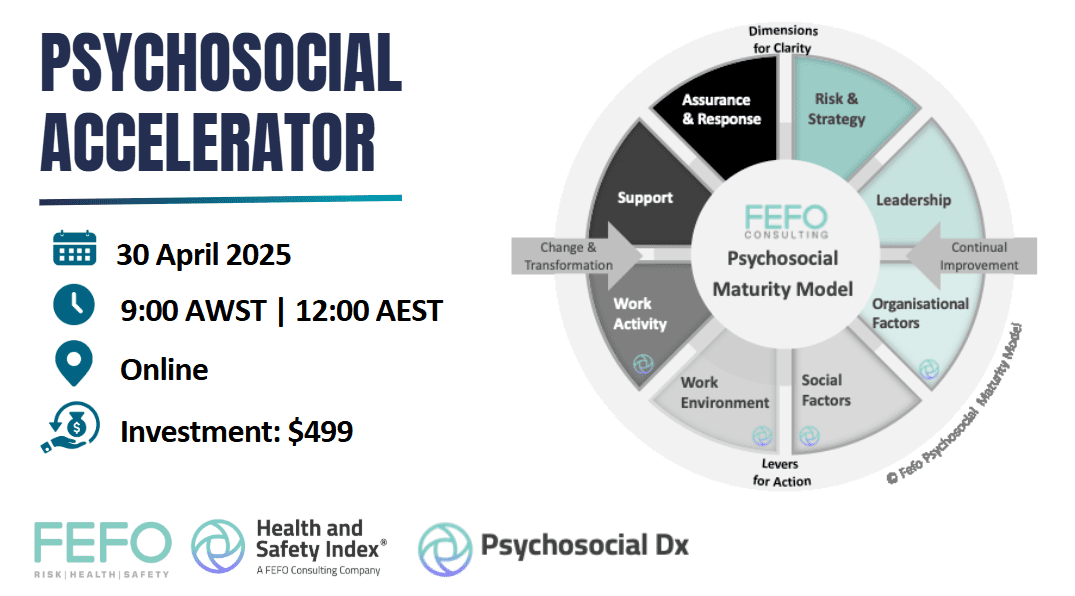
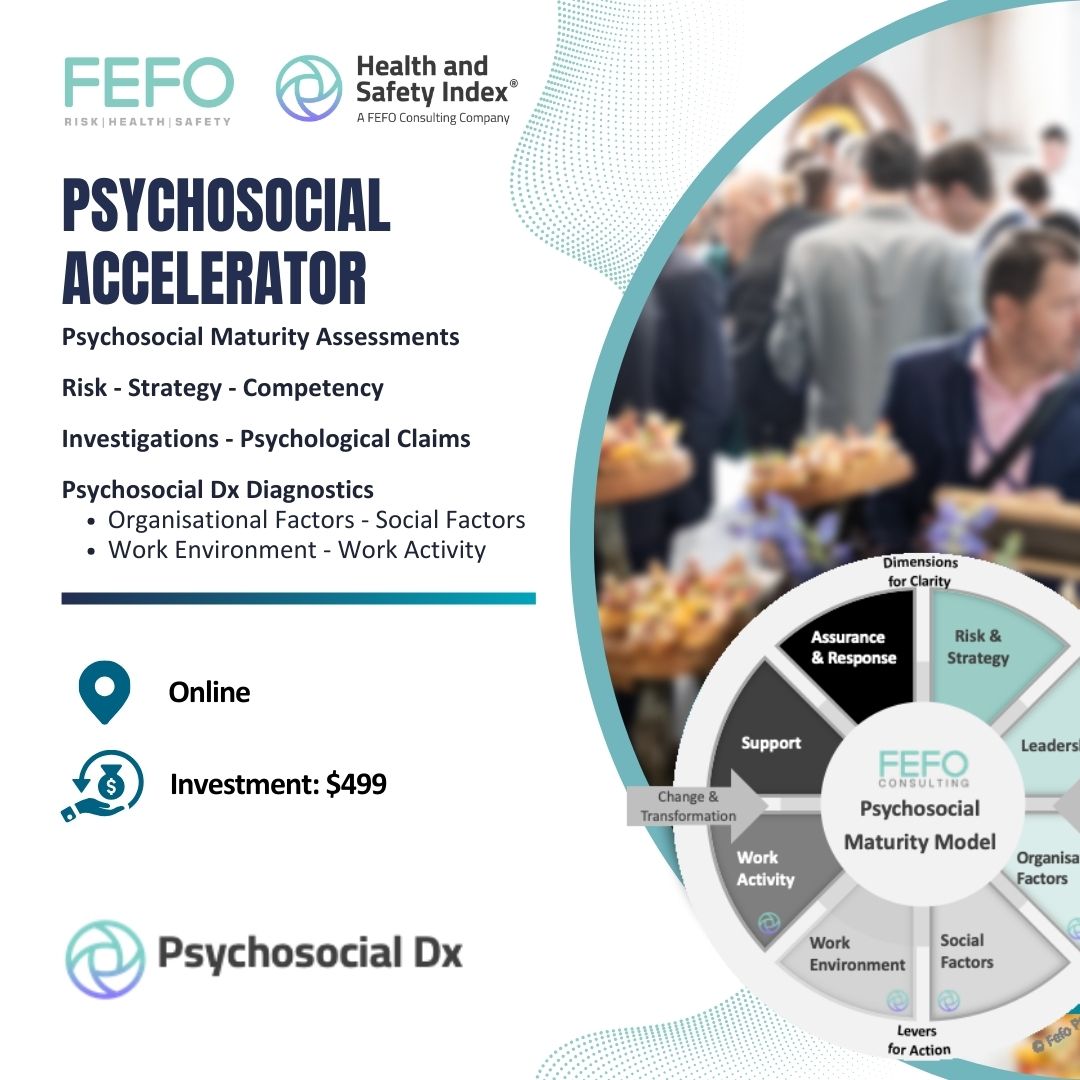
Move from Awareness to Action with Our 90-Day Accelerator Program
Why it matters?
Investing in psychosocial safety isn’t just about compliance—it’s about creating a thriving, resilient workplace. Effective risk management starts with identifying blind spots, implementing early intervention strategies, and ensuring leadership capability is aligned with strategic decision-making.
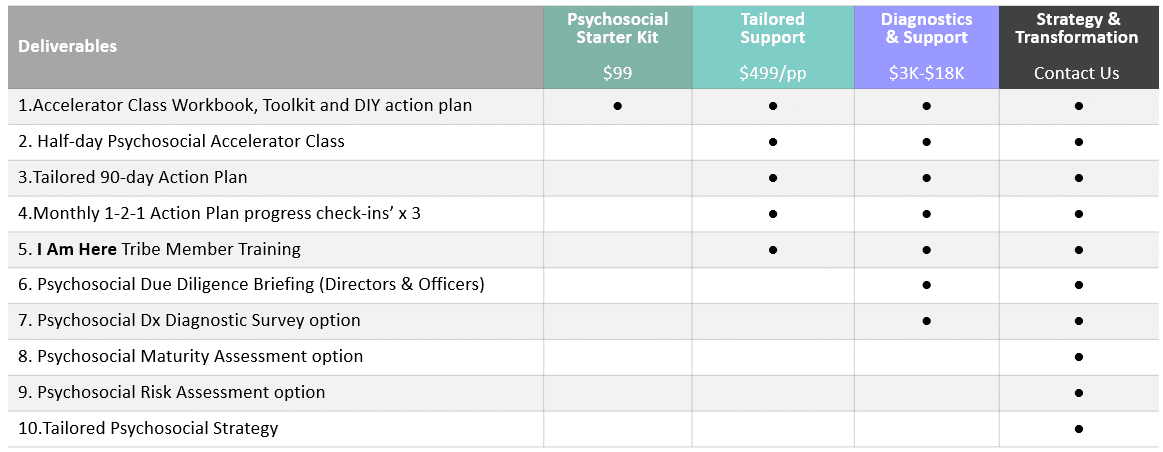
What’s included in the program?
Who should attend?
Safety professionals
Health & wellbeing professionals
Injury management professionals
Business leaders
Learning Objectives
Diagnostics: Understand research-informed methods to ceate a case for change, incuding a Psychosocial Maturity Assessment and Psychosocial Dx diagnostic survey.
Strategy: Apply key steps to an effective psychosocial strategy.
Leadership Capability: Practice techniques to evaluate own skills and build leadership capability of others to improve psychosocial outcomes.
Risk Assessment: Apply methods to evaluate job resources and demands at an organization and job task level.
Investigation: Apply processes for investigating psychological illness cases, claims management and early intervention.
Due Diligence: Understand obligations of Officers to exersice psychosocial due diligence and case law to inform improvements.
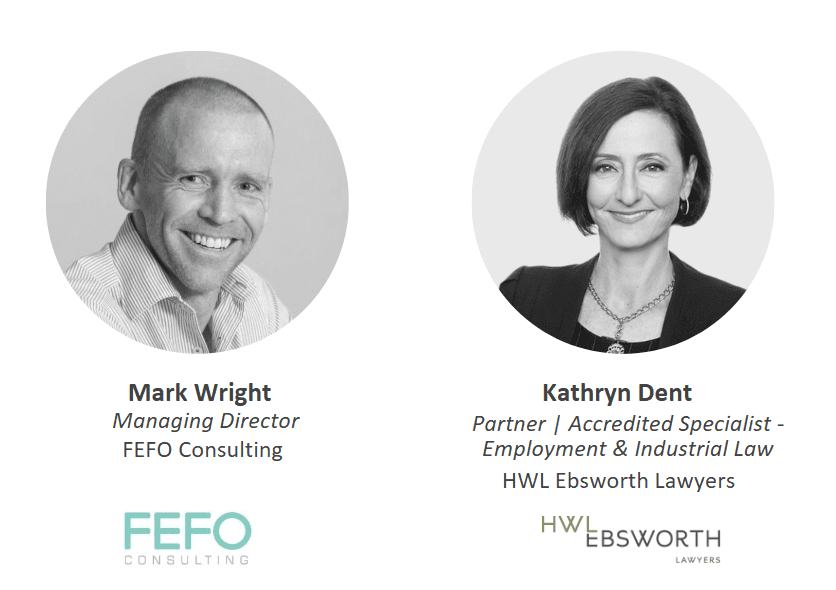
FEFO Consulting collaborated with I Am Here to deliver a 3-part webinar series titled Psychosocial Safety for Leaders hosted by myosh. This series provided practical, easy-to-implement tools to help leaders foster a mentally healthy and safe workplace.
Webinar 1: Psychosocial Blind Spots – Diagnostics to Effectively Manage Risks and Costs
Workplace psychosocial risks are often hiding in plain sight—until they escalate into costly issues. This session will help leaders uncover the most common blind spots that impact workplace wellbeing, productivity, and compliance.
🔍 What we covered: ✔ Identify hidden risks – Discover the psychosocial hazards that often go unnoticed but can have serious consequences. ✔ Practical risk mitigation – Explore simple yet effective strategies to address issues before they escalate. ✔ Data-driven insights – Learn how emerging trends and analytics can improve early detection and intervention.
Equip yourself with the knowledge and tools to proactively manage psychosocial risks and create a safer, healthier workplace.
Webinar 2: Psychosocial Strategy – Boardroom Due Diligence and Influencing Strategic Choices
In today’s workplaces, psychosocial safety is a leadership imperative—but how do you embed it into strategic decision-making at the highest levels?
In this session, we’ll explore how executives and board members can effectively prioritise psychosocial risk management while driving business success.
🏛 What we covered: ✔ Understand your responsibilities – Gain clarity on boardroom due diligence related to psychosocial risks. ✔ Drive leadership conversations – Learn how to start meaningful discussions about workplace mental health with senior leaders. ✔ Embed psychosocial safety in strategy – Discover practical ways to integrate mental health and wellbeing into decision-making.
Webinar 3: Enabling Leadership – Building Capability and Influencing Psychosocial Health
Leadership shapes workplace culture—but how can leaders effectively foster psychological safety while navigating tough conversations and workplace pressures?
In this final session of the Psychosocial Safety for Leaders series, myosh and FEFO Consulting will provide leaders with the tools to build confidence, enhance communication, and influence positive change in their organisations.
🚀 What we covered: ✔ Recognise your impact – Understand how leadership behaviours influence workplace culture, engagement, and performance. ✔ Navigate tough conversations – Gain confidence in addressing sensitive issues with empathy and clarity. ✔ Foster a culture of safety – Learn simple, practical leadership strategies to create a mentally healthy and high-performing workplace.
Empowered leaders create stronger, more resilient teams.
Are you looking to develop your skills further?
Join our 90-day Accelerator Program toequip you with expert knowledge, actionable strategies, and engaging discussions to build a supportive and mentally healthy workplace.
As we approach Christmas, a time that reminds us of the importance of family, community, and connection, we want to reflect on how we can truly embrace the spirit of the season—not just through gifts and celebrations, but through the meaningful ways we show up for one another.
At FEFO Consulting, we’re proud to partner with I Am Here, who encourage us to practice our CLEAR skills every day. This holiday season, we believe these skills—Compassion, Listening, Empathy, Acceptance, and Real Self—are especially important as we spend time with our families and loved ones.
Compassion: Christmas is a time to be kind. Whether it’s a warm smile or a simple act of service, showing compassion helps nurture the connections that matter most.
Listening: In the hustle and bustle of the season, let’s take the time to truly listen. Pay attention to the needs of others, whether it’s their words, actions, or quiet moments. Being present is a gift in itself.
Empathy: Christmas can bring out different emotions, and it’s important to understand and connect with the feelings of those around us. Practice empathy by stepping into someone else’s shoes and offering support where needed.
Acceptance: The holiday season is a time when families come together, and sometimes that means differences of opinion or traditions. Acceptance is about embracing those differences and respecting the individuality of each person, fostering an atmosphere of harmony and understanding.
Real Self: Christmas is about authenticity—being honest and true to who we are. It’s in those genuine, heartfelt moments with others that we find the true meaning of the season.
This Christmas, we want to shift our focus from “things” to “time.” While gifts are a part of the holiday tradition, we believe the greatest gift we can give is our presence.
Handmade gifts, thoughtful gestures, and quality time with loved ones or friends can create lasting memories that far outweigh the value of material possessions. It’s about the thoughtfulness behind the action, the conversations that go beyond the surface, and the shared moments that bring us closer.
Let’s embrace the meaning of Christmas by showing up for each other with compassion, listening intently, offering empathy, accepting differences, and being our real selves. After all, the best gifts we can give and receive are the ones that come from the heart.
Wishing you all a Merry Christmas filled with love, connection, and meaningful moments!
It’s ok not to feel ok; and it’s absolutely ok to ask for help.
As we approach the end of 2023, here at FEFO Consulting we are reflecting back on the year with our core values of giving and gratitude in mind. As a purpose driven firm, our aim has been to provide both purpose and impact to not only our clients, but wider community. With Christmas around the corner and gifts already under the tree, we feel it’s important to acknowledge the impact our team has made on others and share what we believe to be the greatest gift of all: the gift of giving.
So what are the benefits of giving?
According to the International Coaching Federation (ICF) Foundation, giving dually supports both our physical and mental health. In a physical capacity, research shows that supporting others in our community can lower systolic and diastolic blood pressure, leading to increased heart health. Not only this, but generosity also releases endorphins which increase happiness, overall well-being and even an increased life span according to the University of Basel. Despite the idea of ‘giving’ as connoting a giver and receiver, the research shows this is can be mutually beneficial.
“When one person gives to another, both people can benefit.”
Research also points to the fact that those who support causes in their community and give generously have more positive mental health, which is linked to learning success. This means that those who give to others are more receptive to learning new skills and maintaining them. Essentially, giving is a key pillar in our wellbeing and the wellbeing of others!
So how has FEFO Consulting given this year? The team have been busy with supporting their communities in a multitude of ways! Between beach clean ups, giving blood, sport coaching and volunteering at shelters, it’s safe to say that here at FEFO we committed to creating a positive impact in our local communities! While this held a lot of purpose, the team wanted to broaden the scope of giving on a global scale, which is exactly what we did.
About Plan International and our Impact
Plan International is a charity that supports girls’ equality in developing countries, with all sponsorship money going directly towards implementing programs that tackle discrimination, exclusion and vulnerability. As a company, we believe that educating young women in developing countries a great way to break the poverty cycle, and were able to see this through one of the young women we sponsored. Aileen is one example of a young woman FEFO Consulting has supported and has enabled her to achieve her own milestones such as buying her first printer and graduating!
“If you have dreams there are many ways to get it.
To Sir Mark and company, thank you for helping me with my studies…. It helps me a lot and also my family. I am motivated and inspired to do better in my studies because of you Sir. Thank you for the never ending support…“
Aileen (Student in Phillippines)
As of 2023, we have committed to sponsoring 12 young girls through Plan International with the aim of supporting them through an education and towards self-sufficiency. We have all gained an incredible amount of joy through our engagement with Aileen and couldn’t be happier that we are extending the experience to others in need next year.
If you wish to also support this amazing initiative, follow the prompts and donate today.
Giving with Purpose
4-Part Webinar Series
Psychosocial Risk
FEFO Consulting collaborated with several partners to deliver a 4-part webinar series of psychosocial risk. These webinars outlined options to identify psychosocial hazards and manage associated risks.
Our expert facilitators provide insights into Health and Safety Index benchmark results, industry trends and a range of psychosocial resources.
4-Part webinar series:
ISO 45003 vs Model Code of Practice – Getting started: 19 Oct
Change Management – Managing Psychosocial Risks: 26 Oct
Mental Fitness – Opening up Conversations: 9 Nov
HR vs Safety – Psychosocial Ownership: 16 Nov
Contact us to receive a complimentary Psychosocial Risk Assessment template
This is part 2 of 4 of a psychosocial webinar series in partnership with change management experts Levant Consulting. Research has shown that initiatives implemented with effective change management activities are six times more likely to succeed. This webinar will outline highlight why the management of change is important and tips to successfully management transformational change.
Key takeaways:
• Why is change important?
• Health and Safety Index change management benchmark results
• Planning a successful change transformation and taking a human centred approach.
Health and Safety Index Bechmark Data: Change Management
Levant Consulting: Change Management Experts
For a detailed comparison, press the download button to receive a copy of our Psychosocial Hazard Factsheet: ISO 45003 vs Code of Practice.
This is part 3 of 4 of psychosocial webinar series in partnership with Gotcha4Life.
Key takeaways:
Why open up the conversation?
Tips to engage, educate and empower by building mental fitness
Examples of creating meaningful mateship, emotional muscle, and social connection to end suicide.
Be Brave – Ask for help
Gotcha4Life: Working on our Emotional Muscle
4. HR vs Safety
This is part 4 of 4 of psychosocial webinar series in partnership with Hull Consulting. This webinar will outline risk management principles and options when assigning ownership and managing psychosocial factors.
Key takeaways:
Psychosocial factors and relationship between Human Resources and Health & Safety function
Considerations when assigning the management of psychosocial risks
Tips to collaborate, assign ownership and effectively manage psychosocial risk
If you need help with Health and Safety, Well-being or Psychosocial maturity assessments, risk assessments, strategy, training, or other specific interventions – contact us today via email or call +61 1300 909 649
Sign up for industry leading news, case studies and informative videos…
IQA Online Workshop
This is why The Institute of Quarrying Australia (IQA) has partnered with FEFO Consulting, Marina Reid Wilson, Registered Psychologist with a Masters of Science in Coaching Psychology to deliver a Mental Health & Wellbeing Awareness Online Workshop for all levels of people within an organisation.
So gather your colleagues to learn about:
Understand the prevalence of mental ill-health and its impacts
Recognise signs & symptoms e.g. typical psychosocial risk factors
Respond with the right professional help and resources
Prevent by designing healthier workspaces that promote wellbeing for teams and individuals
Marina Reid Wilson is an experienced Registered Psychologist and Masters-qualified Coach with over 15 years’ experience in executive coaching, workshop design and facilitation, and psychological assessment. She has special interest in leadership development and assisting her clients to build resilience, develop emotional agility and flourish in stressful environments.
In recent years, the attention on mental health in the workplace and community has increased substantially. Greater levels of attention is a positive step to improving a very challenging and often stigmatised topic. The Health and Safety Index benchmark results 2020 vs 2021, reported improvements in responses to “I feel comfortable talking about mental health” ↑ up 5%. This was the greatest positive improvement of all 55 benchmark questions.
Despite this improvement, the actual Health and Safety Index benchmark results for “feeling comfortable talking about mental health” are in the bottom quartile, indicating we have a long way to improve compared to other health and safety behaviours, conditions and practices.
We have also seen the introduction of several international and domestic guidance materials from regulators to assist with managing psychosocial factors in the workplace, e.g.
This article specifically provides a comparison between:
ISO 45003: Occupational health and safety management – Psychological health and safety at work – gives guidance on managing psychological health and safety risks; and
SafeWork Australia: Model Code of Practice: Managing psychosocial hazards at work.
For a detailed comparison, press the download button to receive a copy of our Psychosocial Hazard Factsheet: ISO 45003 vs Code of Practice.
Standards vs Code of Practice
In general terms, Codes of Practice provide detailed information on how you can achieve the standards required under Work Health and Safety (WHS) laws. Codes of Practice do not replace the WHS laws, but can be help provide an understanding on how to apply legal requirements.
Worth noting, Victoria will be the first jurisdiction in Australia to legislate the specific requirement for psychosocial risk assessments.
Similarities: ISO 45003 and Model Code of Practice
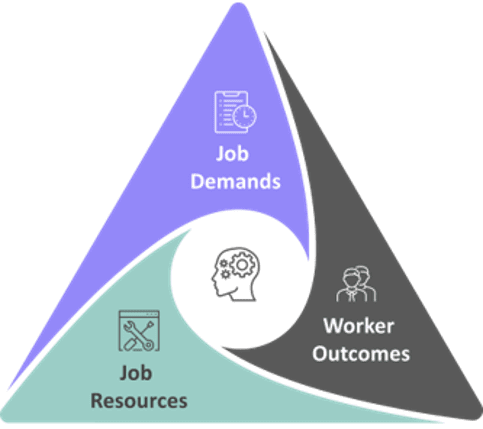
There are many common areas between ISO 45003 and the Code of Practice. Both documents address psychological health sources of harm and potential risk factors covering both job demands and job resources. Both of these documents provide guidance on the management of psychosocial workplace factors in relation to:
Design or management of work
Process and system
Working environment
Plant and equipment
Interactions, cultures, values and behaviours.
Interestingly, both documents are very limited in their guidance on worker impacts and outcomes.
Differences: ISO 45003 vs Model Code of Practice
Despite ISO 45003 being 50% smaller by page number compared to the Code of Practice, it really provides a detailed outline managing psychosocial risks. Key distinctions with ISO 45003, are as follows:
ISO 45003
One of the most obvious differences between ISO 45003 and the Code of Practice is the structure of the guidance. ISO 45003 provides broader considerations to enable alignment with ISO 45001 OHS management systems (Plan-Do-Check-Act). This guidance is great for organisations with mature systems who can simply integrate the management of psychosocial factors into existing systems and practices. For more information on the relationship with ISO 45001, refer to our ISO 45003 vs 45001 blog.
ISO 45003 provides a greater guidance on the following areas:
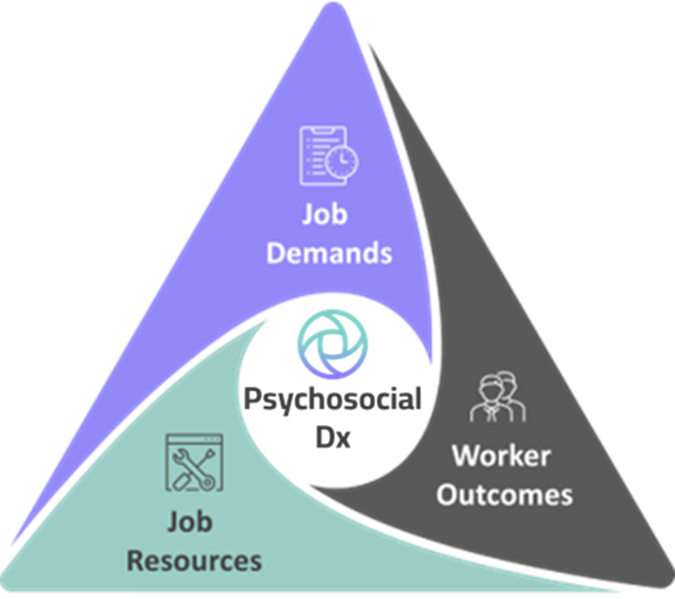
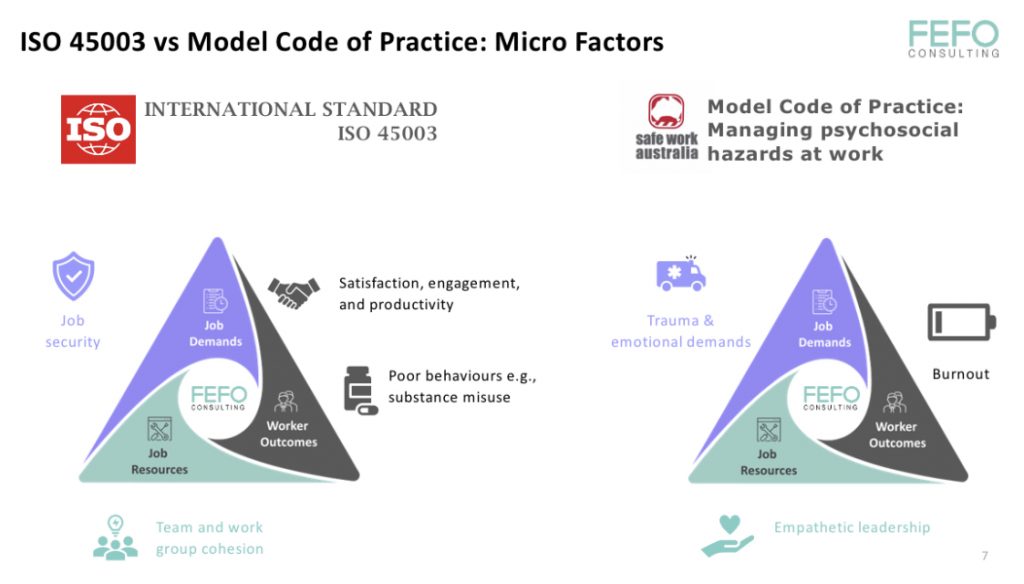
Job Demands: Greater focus on job security, uncertainty regarding work availability, non-standard employment that is low paid and/or insecure and working in situations that are not covered or protected by traditional employment laws or social protections.
Job Resources: Greater focus on team and work group cohesion. It also provides a more detailed outline of leadership behaviours and activities Leaders can undertake.
Definitions: Provides more comprehensive definitions, e.g., wellbeing, physical, mental, social, and cognitive health.
Model Code of Practice
Compared to ISO 45003, the Code of Practice is structured to align with operational risk management principles (ID-Assess-Control-Review-Record-Investigate). Other key differences are the emphasis on trauma, emotional demands, and empathetic leadership. Although trauma is often associated with acute events, it also can be chronic or cumulative, e.g., “compassion fatigue” and repeated exposures to emotional situations. Compared to ISO 45003, the Code of Practice has a greater focus on the following areas:
Structure: Aligned with risk management principles of hazard identification, risk assessment, risk control Review-Record-Investigations
Job Demands: Greater focus on trauma and emotional demands
Job Resources: Greater focus on empathetic leadership
Appendix: Provides an example Risk Register.
Summary: ISO 45003 vs Model Code of Practice
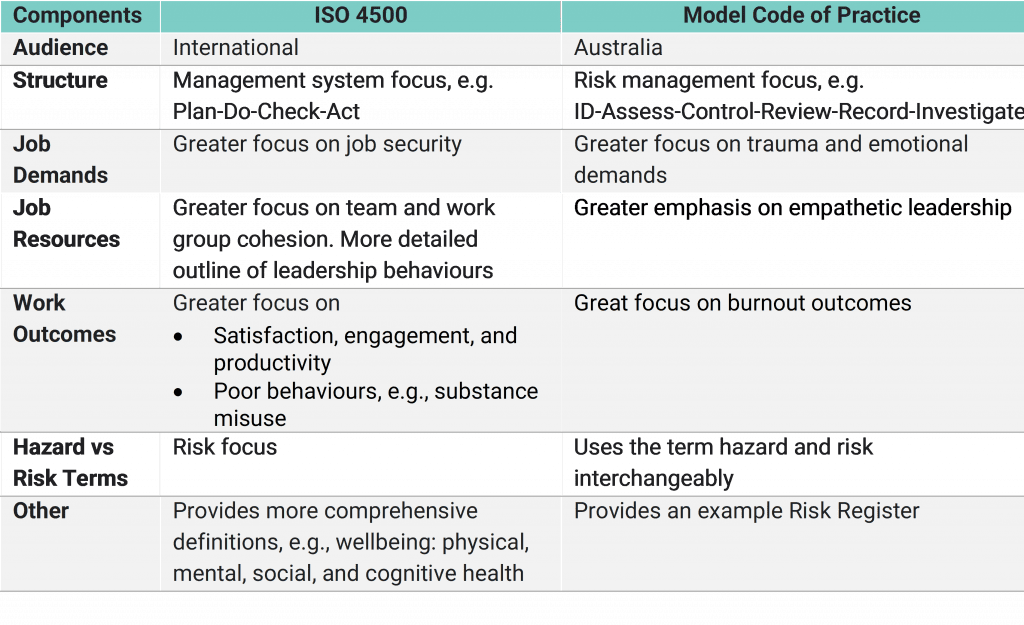
A summary of key differences between ISO 45003 vs Code of Practice are outlined in Table 1 below
Table 1: ISO 45003 vs Model Code of Practice Summary
For a more detailed comparison, press the download button to receive a copy of our Psychosocial Hazard Factsheet: ISO 45003 vs Code of Practice.
FEFO Consulting has partnered with the Health and Safety Index to design integrated online assessments to measure health AND safety performance supported by reliable benchmarks.
If you need help with Health and Safety, Wellbeing or Psychosocial maturity assessments, risk assessments, strategy, training, or other specific interventions – contact us today via email or call +61 1300 909 649
Do companies focus too much on individuals and lower order controls?
Too often organisations focus on individuals and lower order controls such as training and mindfulness, rather than focusing on job design, job demands and organisational resources.
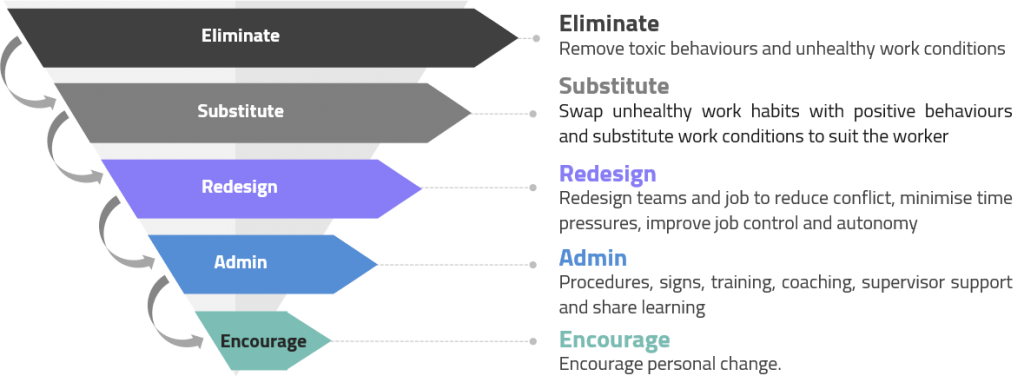
The ‘Hierarchy of Controls Applied to NIOSH Total Worker Health’ provides a conceptual model for prioritising efforts to advance the safety, health, and wellbeing of all workers.
NIOSH1 Total Worker Health Hierarchy of Controls
Manual Handling Analogy
If the job demands of lifting boxes was too difficult, would you:
a) Provide education and tell the work to visit the gym and getter fitter
or
b) Complete an assessment to determine job demands, job resources and apply the hierarchy of controls, e.g. eliminate the load, swap load with a lighter product and / or provide lifting aids.
Health & Wellbeing
Psychosocial hazards are not universally understood and often much harder to evaluate compared to physical safety hazards, e.g. the impact of a heavy box leading to a sprain or strain.
The hierarchy of controls has been a legal requirement for many years. That alone, it not the sole reason to apply the hierarchy of controls to psychosocial risks. If a company can redesign the job demands to match the needs of a worker, it just makes sense.
Realistic time pressures2 are often associated with lower health and wellbeing performance. Understanding both job demands, job resources and effective controls are critical to understanding the impacts on worker health & wellbeing.
Conclusion
Taking a risk based approach to health and wellbeing is a logical, yet sometimes challenging activity to complete effectively.
We recommended assessing psychosocial risk using the latest research and expert advice, rather becoming overly reliant on training and other lower order controls.
Applying the hierarchy of controls to tasks to job demands, job resources and worker outcomes can reduce risk and provide a positive Return on Investment (ROI)3.
Have you completed a formal assessment to determine the health and wellbeing controls that are relevant to your organisation?
Contact us to learn more:
M: +61 1300 909 649
E: info@fefo.com.au
Source1: Adapted from NIOSH [20160]. Fundamentals of total worker health approaches: essential elements for advancing worker safety, health, and well-being. By Lee MP, Hudson H, Richards R, Chang CC, Chosewood LC, Schill AL, on behalf of the NIOSH Office for Total Worker Health. Cincinnati, OH: U.S. Department of Health and Human Services, Centers for Disease Control and Prevention, National Institute for Occupational Safety and Health, DHHS (NIOSH) Publication No. 2017-112.
Source3: Creating a mentally healthy workplace: Return on investment analysis, PwC
FEFO Consulting was requested to present at the recent Workplace Health and Safety Show 2020 on the engaging topic of mental health & wellbeing.
Often what we have seen in organisations that we work with is that until now they have taken a generic approach to developing mental health & wellbeing programs and setting up services.
Organisations are now beginning to understand the benefits of taking a risk-based approach to mental health & wellbeing. Tailoring the solution is resulting impacts an organisation’s culture as well as improving productivity, staff cohesion, and retention.
To find out more on our approach, listen Kate Power and Sally Boucher by clicking on the video link below.
What we do
We help organisations simplify critical aspects of health and safety by strengthening controls and enabling high performance.