
FEFO Consulting

Psychosocial Dx Survey

Uncover and Act of Psychosocial Risks with Confidence

what

Psychosocial Dx

We help organisations evaluate organisational psychosocial performance with a statistically reliable and valid survey. Aligned with psychosocial factors outlined in ISO 45003 standard and codes of practice, our diagnostic climate survey supports the identification of hazards, potential impacts and areas for improvement

why

Why choose Psychosocial Dx?

It is often difficult to target the correct solutions, without a valid diagnosis. Psychosocial hazards are often invisible, making workforce feedback essential for identifying and addressing these factors effectively. 

  • Reliable Benchmarks: Enables clarity with statistically reliable and valid data to benchmark performance trends.  
  • Insights: Provides targeted diagnostics to inform effective decision making and psychosocial risk assessments. 
  • Scalable & Efficient: Consults with your workforce at scale to uncover factors that may otherwise go unnoticed in less than 10min. 
how

How is this Achieved?

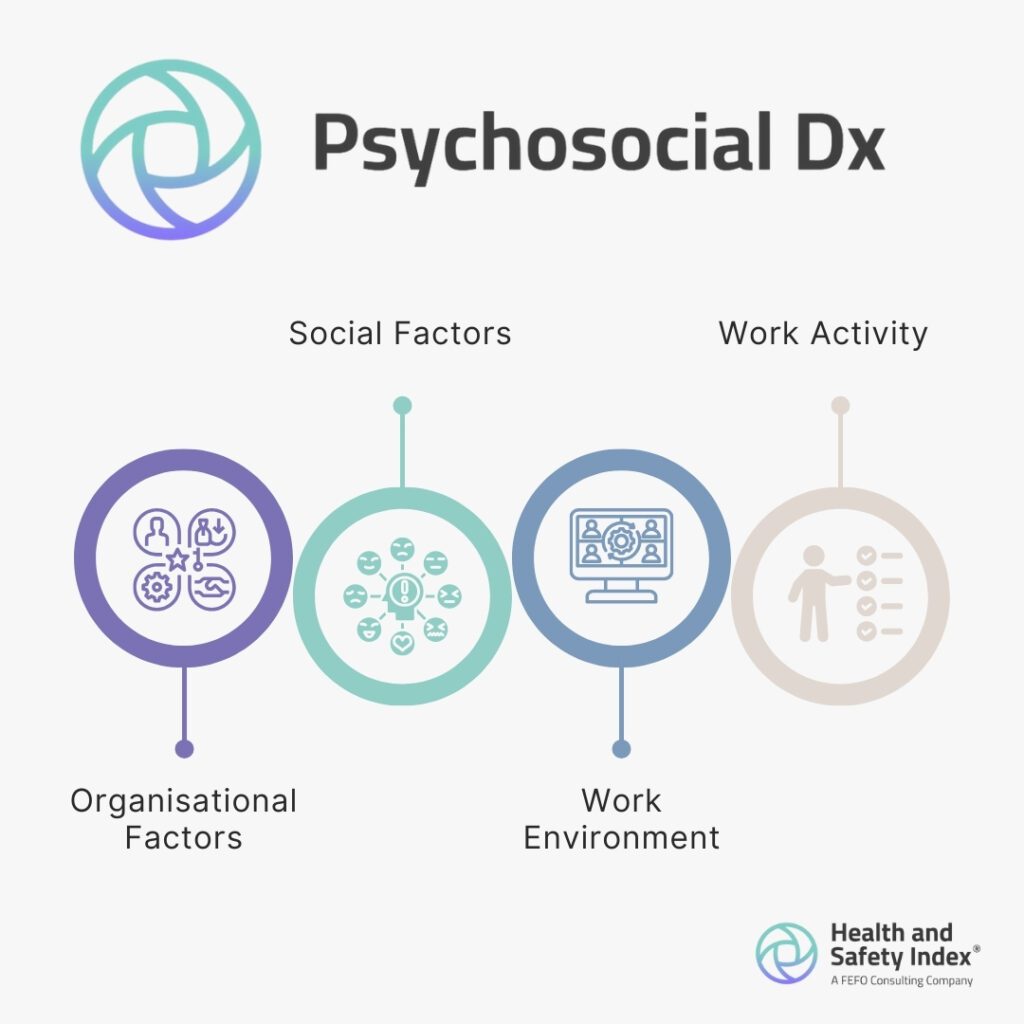
The Psychosocial Dx survey displays results in a way to support decisions gathers feedback on psychosocial risks across four key aspects:

  • 1 Index: Aggregated results of overall Performance:
  • 4 Aspects: Organisational factors Social factors, Work environment and Work activity
  • 7 Dimensions: Specific psychosocial factors
  • 8 Outcomes: Impacts on sleep, burnout, mental health, pain, leave etc.
  • 12 Levers: Actional insights prioritised to inform future intervention and Return on Investment (ROI).

Try our free Psychosocial Dx sample survey and get a sample report.


“Companies identifying and addressing psychosocial risks see 50% fewer mental health-related absences, contributing to higher team productivity.” (Source: World Health Organization, 2021)

How is this Achieved?

FAQs

2.) What are the most common psychosocial hazards Australian employers need to manage?
Common hazards include high/low job demands, low job control, poor role clarity, inadequate support, workplace conflict, bullying/harassment (including sexual/gender‑based), violence/aggression, traumatic events, poor organisational change management, inadequate recognition, and remote/isolated work.
JD-JR-WO evidence links demands to burnout and resources to engagement, across multiple occupations.

3.) How do psychosocial hazards cause harm and what worker outcomes should we track?
Prolonged or intense stress from psychosocial hazards can cause psychological harm (e.g., anxiety, depression, PTSD, sleep disorders) and physical harm (e.g., fatigue‑related injuries, musculoskeletal issues).

In JD-JR-WO terms, demands → burnout/exhaustion while resources → engagement; burnout mediates the path to health problems, whereas engagement links to positive outcomes (e.g., lower turnover intention, better service quality).

4.) What are our legal duties in Australia and how does JD‑JR-WO help prove “reasonably practicable” risk management?

PCBUs must eliminate or minimise psychosocial risks, consult workers, apply the hierarchy of controls, and review controls—obligations now explicit in codes and regulations (e.g., NSW Code of Practice).
Using JD‑JR-WO, you systematically identify demands/resources, assess interactions, then control by redesigning work to reduce demands or increase resources first (higher‑order controls), before relying on training/EAP (lower‑order).

5.) How does FEFO Consulting apply the JD‑JR-WO model in Australian workplaces?

  • JD‑JR Rapid Assessment: Classify psychosocial factors and existing controls as Demands, Resources, Job Resources or Worker Outcomes; map hot‑spots by business unit; consult workers in line with the Code.
  • Control Bundles: Pair demand‑reduction (e.g., workload levelling, change pacing) with resource‑boosting (e.g., role clarity, supervisor capability, procedural justice) for durable risk reduction.
  • Governance & Metrics: Build board dashboards around JD‑JR pathways—Demands → Burnout/Incidents and Resources → Engagement/Performance—to evidence continuous improvement.

Refer to the Psychosocial Risk Assessment webpage to understand how to use diagnostic surveys to inform risk. 

Refer to the Psychosocial Performance Assessment webpage to understand how to use diagnostic surveys to inform how to combine survey data with other inputs for a holistic understanding of your organisation’s psychosocial performance.

What we do

We help organisations simplify critical aspects of health and safety by strengthening controls and enabling high performance.