
The Health and Safety Index
The Health & Safety Index recently engaged a Murdoch University PhD to evaluate the psychometric properties of our online assessment tool.
The Health & Safety Index is a simple online assessment enabling organisations to talk with their workforce and receive feedback at scale. This helps target areas of focus to inform strategy and enable a high-performance culture. Even more important now, with an increasing remote workforce!
The survey takes less than 10 min. Unlike traditional surveys that often only cover safety culture, the Health and Safety Index covers four key aspects:
1. Safety Leadership
2. Safety Engagement
3. Health & Wellbeing
4. Safety Systems
Validation Review Results
The results of Health and Safety Index review involved n=471 participants and included:
– Reliability: Statistical reliability of aspects were evaluated to be greater 0.90 or “excellent”. This is substantially higher compared to other common safety climate surveys1,2.
– Key Finding: This study demonstrated a 0.86 positive correlation between separate Employee Engagement (n-22) vs Safety Engagement (n=22) questions.
– Levers: The outcomes of this study identified eleven “Levers” that can be uniquely measured in each survey report to help organisations target specific areas of focus.
Conclusion
The Health and Safety index aspects were evaluated as having a reliability of >0.90 or “excellent”.
High performance organisations should consider using WHS as a key component of improving employee engagement and visa-versa, e.g. WHS and Human Resource (HR) teams collaborating effectively to achieve common goals.
During the unprecedented times of personnel working remotely, the Health and Safety Index is a great way to engage the workforce at scale, receive feedback, and improve both WHS and employee engagement.
Additional Research and Resources
Refer to the Health and Safety Index Research and Resources page to obtain more information and evidence.
1. Kines P, Lappalainen J, Mikkelsen KL, Olsen E, Pousette A, Tharaldsen J, et al. Nordic safety climate questionnaire NOSACQ-50): A new tool for diagnosing occupational safety climate. Int J Ind Ergon. 2011;41:634-646
2. Cox SJ, Cheyne AJT. Assessing safety culture in offshore envi-ronments. Saf Sci. 2000;34:111-129
Q1. What is unique about the Health and Safety Index?
1. Wholistic: Unlike traditional safety culture surveys, the Health and Safety Index covers 4 aspects in approx. 10min!
These 4 aspects include Health & Wellbeing, Safety Leadership, Safety Engagement and Safety Systems that help inform strategic choices.
2. Employee Engagement: The Health and Safety Index has an integrated set of employee engagement questions. Employee engagement is commonly used as a lead indicator to improve organisational culture, people and performance.
3. Tailored: Our solution allows for business specific demographic data to help identify hotspots and comparisons between cohorts, e.g. positions, locations, age, genders and business units. This informs strategic choices, a targeted use of resources and a positive Return on Investment (ROI).
4. Reliable: An independent empirical study by a Murdoch University PhD concluded the reliability of the Health and Safety Index was “Excellent” (r >0.9). This allows organisations to apply the Health and Safety Index with confidence, again and again.
5. Valid: Our solution has research informed questions and meaningful reports based on statistically reliable “Levers” and “Outcomes”.
6. Insightful: Receiving feedback at scale allows you to hear things, you can’t normally hear. Our impartial and expert interpretation allows you to see things you can’t normally see!
Q2. Does the Health & Safety Index help evaluate safety culture?
A: Yes, and more. The Health & Safety Index is a set of integrated questions adapted from academic research as a lead indicator to workplace culture. Our survey evaluates four key aspects:
1. Health & Wellbeing
2. Safety Leadership
3. Safety Engagement
4. Safety Systems.
Once the survey is completed a report is provided outlining areas of focus based on health and safety beliefs, values, behaviours and experience. Understanding these areas of focus, helps organisations build a high-performance culture.
Q3. Does the Health & Safety Index evaluate health and wellbeing?
A: Yes. The Health & Safety Index covers four key aspects:
1. Health & Wellbeing
2. Safety Leadership
3. Safety Engagement
4. Safety Systems.
We have mapped health and wellbeing questions to align with industry leading psychosocial assessment tools allowing the evaluating of Job Demands, Job Resources and Worker Outcomes. Results help inform strategic decision making to enable a psychologically safe workplace.
Q4.What is the ‘Health & Safety Index’?
The ‘Health & Safety Index’ is a simple online assessment enabling organisations measure, focus and act on valuable data that matters.
► 4 Aspects: We have designed an integrated set of survey questions to provide a holistic view covering 4 key aspects.
► 7 Dimensions: Results can be compared across your business-specific demographics and 7 drivers to measure, focus and act on areas that matter.
► 1 Index: Results are consolidated to provide 1 index for tracking and benchmarking results overtime to monitor progress and build high levels of performance.
Q5. How much does the ‘Health & Safety Index’ cost?
Refer to our website for pricing and contact us.
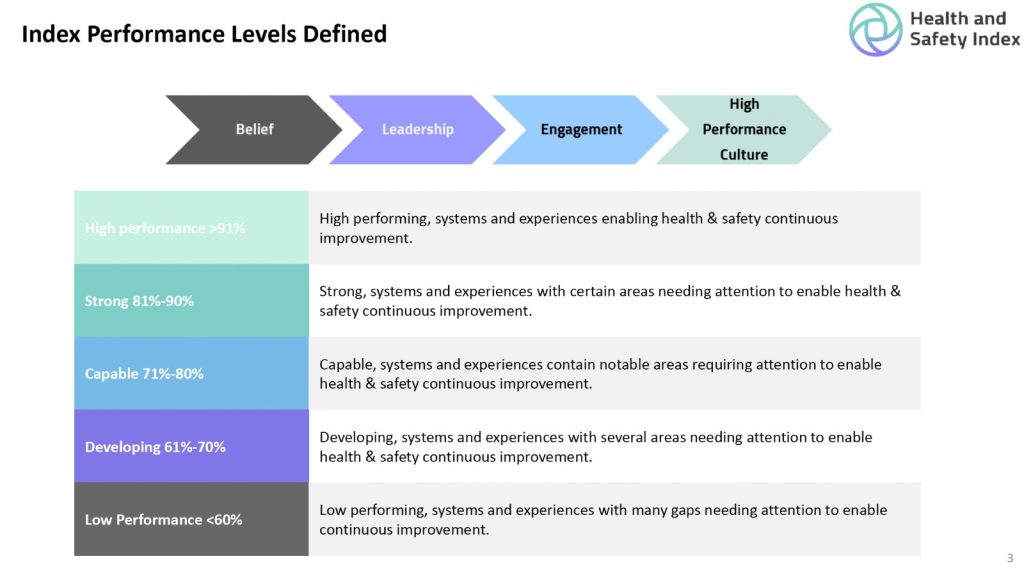
Q6. What is the meaning of each of the Health and Safety Index performance levels?
Refer to descriptions in the image below 👇

Exciting times this week launching the Health and Safety Index!
We have partnered with approximately 10 organisations as part of a review by a Murdoch University PhD. Refer to our Research and Resources page to understand outcomes of this review.
FEFO Consulting was engaged to complete a review the Workplace Health & Safety (WHS) function of NSW Government Department of Planning & Environment. Various aspects of safety culture and teamwork were evaluated and reassessed after 12 months. The results demonstrated a remarkable step change and safety culture and team performance.
• Team design did not align with stakeholders, activity & locations
• Job design not aligned to work
• Accountability, trust and morale was low
• Safety team and function assessment
• Recruited 17 new roles, including a new WHS Director
• Right people, Right place!
• WHS Function Overall Performance up 39%
• Greater operational presence up 50%
• Team Engagement & Motivation up 37%
• Team members willingness to call out unproductive behaviour up 36%
• Team role clarity up 27%